1. Home
  2. Healthy living and participation
  3. Zelfzorg en dagelijkse taken
  4. Zelfstandig blijven functioneren

What do you think of our website?

We would love to hear what works well and what could be better. Your feedback helps us improve our website.

What would you like to give feedback on?

Read how we use feedback data.

Please note: Do not share medical details or a citizen service number (BSN).

Rondom – Het leven loopt lekkerder
Nederlands
  • Employers
  • Partners
  • Research
  • Working at
Rondom app
Ordering insolesAfspraak maken
Rondom – Het leven loopt lekkerder
Afspraak maken
Rondom – Het leven loopt lekkerder

We’d be happy to help you further.

  • info@rondomlopengroep.nl
  • 088-1180570

Need help?

  • Frequently Asked Questions
  • Reimbursement
  • Complaints procedure
  • What does your health insurer cover?

Contact

  • Book an appointment

Need help?

  • Frequently Asked Questions
  • Reimbursement
  • Complaints procedure
  • What does your health insurer cover?

Contact

  • Book an appointment

Services

  • Occupational therapy
  • Lifestyle and Dietetics
  • Podiatry and chiropody care
  • Psychology and social work
  • Physiotherapy
  • Rondom in Business
  • Rondom Shoes

Discover Rondom

  • Healthy living and participation
  • Activities
  • Rondom app
  • Social impact
  • Research

About Rondom

  • Current
  • Find a location near you

Follow Rondom

LinkedInInstagramFacebook

Life runs more smoothly.

General (payment) terms and conditionsPrivacy StatementCookie Policy
  • What do you notice?
  • What might be the reason for this?
  • What can you do yourself?
  • When is it advisable to seek help?
  • How Rondom can help
  • Download the Rondom app
  • Make an appointment

To continue to function independently

Are you worried that you’re becoming less independent? Perhaps you’ve noticed that you need help more often or that everyday tasks are taking you longer. Or that you no longer feel confident doing certain things on your own. This can have a big impact on you. Independence isn’t just about practical tasks. It’s also about freedom, making your own choices and feeling that you’re in control of your life. Continuing to function independently does not mean you have to do everything on your own. Sometimes it actually helps to arrange support, aids or adjustments in good time. That way, you can carry on doing what is important to you, in a way that remains safe and manageable.

To continue to function independently
What do you notice?

A decline in independence can develop gradually. Often, a person adapts step by step, without it being immediately clear how much has changed.

You may, for example, notice that:

  • daily tasks take up more time;
  • you ask your partner, family or neighbours for help more often;
  • you avoid certain activities;
  • you find it harder to go outside;
  • you’re afraid of falling over or doing something wrong;
  • you find it difficult to plan or keep track of things;
  • you get tired more quickly after carrying out everyday activities;
  • you feel more dependent than you would like.

Sometimes you notice it most in the little things. A message that goes unanswered. An appointment you cancel. A flight of stairs you’d rather avoid. It is precisely these signs that are important.
What might be the reason for this?

Related topics

  • Coping with pain, fatigue or limitations whilst managing your own care

    Do you experience pain, do you tire easily, or do you find that your body doesn’t always do what you want it to? If so, everyday self-care tasks can suddenly become very demanding. Taking a shower, getting dressed, preparing a meal or starting your day can then feel like a real struggle. This isn’t just an excuse. These are everyday activities that require a lot of energy and movement. If self-care becomes more difficult, it can affect how you start your day. Perhaps you need to rest first before you can do anything else. Or you might be saving your energy for work, family or appointments, and self-care ends up taking a back seat. In the long run, this can take a heavy toll on you.

  • Daring to ask for help

Was this information helpful?

Independence can come under pressure due to physical symptoms, tiredness, pain or a loss of strength. Problems with balance, memory, concentration or planning may also play a part.

In addition, your living environment may no longer be well suited to your needs. Consider, for example, a home with steps, a busy schedule, little support in the neighbourhood, or tasks that are not properly organised.

Changes in health or life stage can also have an impact. Following illness, an operation, overexertion or prolonged stress, it may take time to rebuild confidence.

What can you do yourself?

It helps to take a close look at what you want to continue doing yourself and where support would be welcome. You can often maintain your independence more effectively if you organise your tasks sensibly.

For example, you could:

  • write down which tasks have become difficult;
  • choose which things are most important to you;
  • ask for help with demanding tasks, so that you have energy left for other things;
  • using aids where it is safe and comfortable to do so;
  • establish fixed routines for recurring tasks;
  • making your home safer and more organised;
  • plan activities for times when you have more energy;
  • practising small steps to regain confidence.

Staying independent also means that you are free to make your own choices. Not everything has to be the way it used to be. The important thing is that your life continues to reflect what you are capable of and what matters to you.

When is it advisable to seek help?

It is wise to seek help if you notice that your independence is declining or if you are concerned about this. It is also a good idea to seek advice if you are avoiding activities, falling more often, needing a lot of help or feeling overwhelmed.

Ask for help if your loved ones are concerned. Sometimes, the people around you notice first that daily life is becoming more difficult. This can be difficult to face, but it can also help to arrange appropriate support in good time.

How Rondom can help

Together, we’ll look at what you need to continue living as independently as possible. This isn’t just about what you can no longer manage, but above all about what you want to keep doing.

A occupational therapist can help with daily tasks, assistive devices, home adaptations and managing energy levels. A physiotherapist can help build strength, balance and confidence in movement. A lifestyle coach can help with routine, recovery and healthy habits. In the event of uncertainty, stress or a loss of confidence, it can psychological support should be appropriate.

We look for practical solutions that suit your lifestyle. That way, you remain in the driving seat as much as possible.

Do you find it difficult to ask for help? Perhaps you think others are already busy enough. Or you don’t want to be a burden to anyone. As a result, many people wait too long, whilst asking for help can actually help you to continue functioning more independently and with greater peace of mind. Asking for help is not the same as giving up. It means you are taking your needs seriously. Sometimes, just a little help is enough to get you through the day better. Yet the barrier can be high, especially if you’re used to doing everything yourself.

  • Difficulty eating and drinking

    Have you noticed that eating or drinking isn’t as easy as it used to be? Perhaps you have a reduced appetite, find eating takes a lot of energy, or struggle to eat or drink enough. Pain, tiredness or other health issues can also affect how and what you eat. Eating and drinking well is important for your health. It provides energy, helps your body recover and supports your day-to-day functioning. If eating or drinking becomes difficult, this can affect your fitness, independence and quality of life.

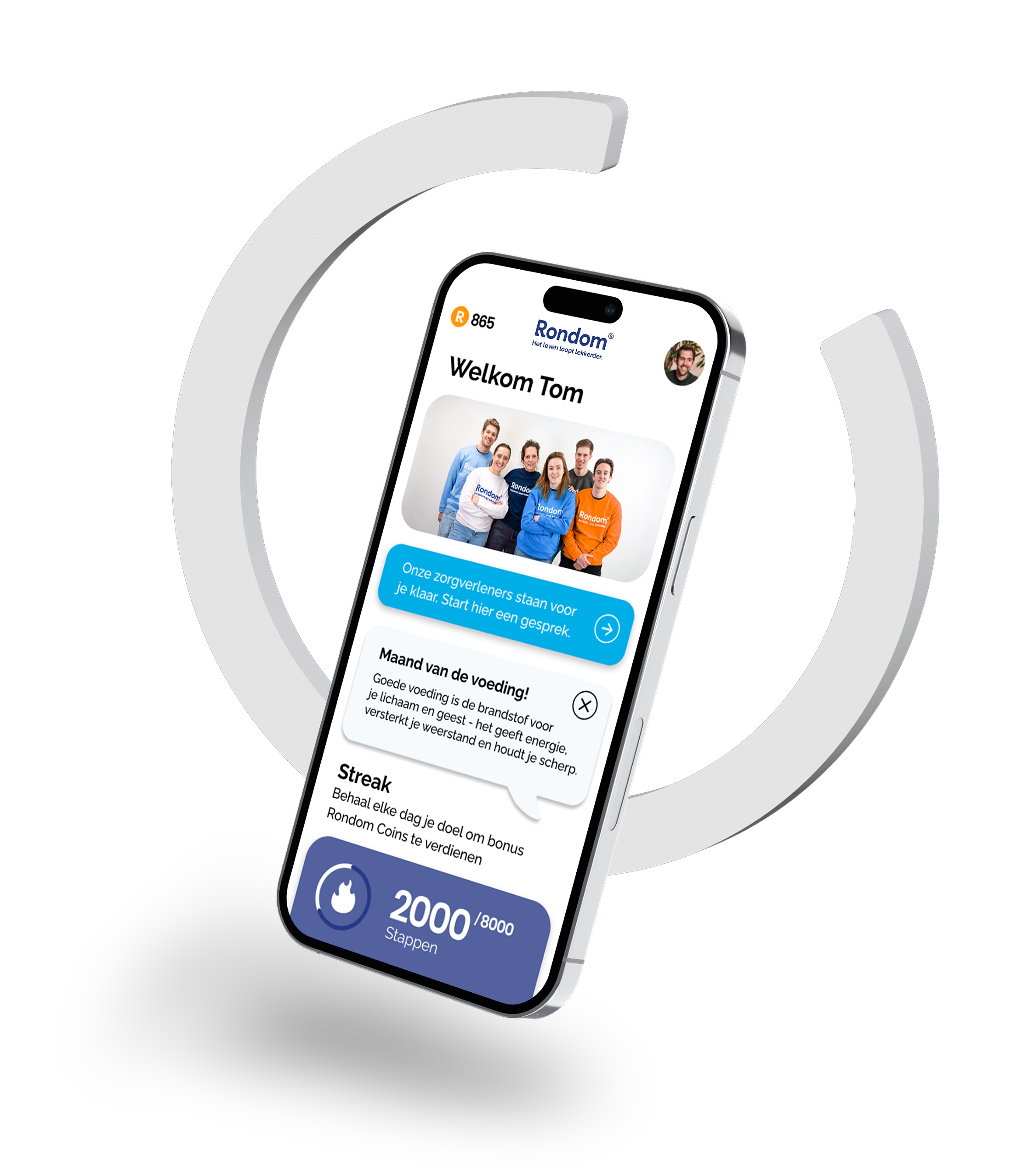
  • Work on your health with the Rondom app

    • Direct contact with healthcare professionals via chat
    • A community where you share experiences and motivate one another
    • Personal challenges that match your goals
    • Step counter for your daily exercise
    • Earn points for healthy choices
    • Articles, videos, recipes and assignments
    • Register for (online) events
    Discover the Rondom app

    Find a healthcare provider near you

    Book an appointmentCall usDownload the Rondom app