1. Home
  2. Healthy living and participation
  3. Sociaal meedoen en eropuitgaan
  4. Weer vertrouwen krijgen om mee te doen

What do you think of our website?

We would love to hear what works well and what could be better. Your feedback helps us improve our website.

What would you like to give feedback on?

Read how we use feedback data.

Please note: Do not share medical details or a citizen service number (BSN).

Rondom – Het leven loopt lekkerder
Nederlands
  • Employers
  • Partners
  • Research
  • Working at
Rondom app
Ordering insolesAfspraak maken
Rondom – Het leven loopt lekkerder
Afspraak maken
Rondom – Het leven loopt lekkerder

We’d be happy to help you further.

  • info@rondomlopengroep.nl
  • 088-1180570

Need help?

  • Frequently Asked Questions
  • Reimbursement
  • Complaints procedure
  • What does your health insurer cover?

Contact

  • Book an appointment

Need help?

  • Frequently Asked Questions
  • Reimbursement
  • Complaints procedure
  • What does your health insurer cover?

Contact

  • Book an appointment

Services

  • Occupational therapy
  • Lifestyle and Dietetics
  • Podiatry and chiropody care
  • Psychology and social work
  • Physiotherapy
  • Rondom in Business
  • Rondom Shoes

Discover Rondom

  • Healthy living and participation
  • Activities
  • Rondom app
  • Social impact
  • Research

About Rondom

  • Current
  • Find a location near you

Follow Rondom

LinkedInInstagramFacebook

Life runs more smoothly.

General (payment) terms and conditionsPrivacy StatementCookie Policy
  • What do you notice?
  • What might be the cause of this?
  • What can you do yourself?
  • When is it advisable to seek help?
  • How Rondom can help
  • Download the Rondom app
  • Make an appointment

Regaining the confidence to participate

Would you like to get back involved, but does it feel like a big step? Perhaps you’ve been out of action for a long time, have had health issues, or have become unsure about what you’re capable of. In that case, returning to activities, work, social engagements or exercise can be daunting. Confidence often doesn’t return of its own accord. It grows through small experiences. Getting back into things doesn’t mean you have to be able to do everything straight away. It’s about discovering, step by step, what is achievable. Sometimes that might be a short visit, a short walk or a chat. Every step can help to make your world a little bigger again.

Gaining the confidence to get involved
What do you notice?

A loss of confidence can manifest itself in many ways.

You may, for example, notice that:

  • you are unsure whether you can cope with something;
  • avoids your activities;
  • you are afraid of a relapse;
  • you spend a lot of time thinking about what could go wrong;
  • you quickly become anxious when you have symptoms;
  • you take less initiative;
  • you need help getting somewhere;
  • when you compare yourself to how you used to be;
  • you feel disappointed when something doesn’t work out.

Sometimes you want to, but fear or uncertainty holds you back. That can be frustrating.
What might be the cause of this?

Related topics

  • Avoiding family visits or social engagements

    Do you find yourself cancelling family visits or social engagements more often than you’d actually like? Perhaps you look forward to an engagement at first, but on the day itself you find yourself dreading it. You wonder whether you’ll be able to cope, whether there’ll be enough rest, and whether others understand what you need. This can cause a great deal of stress. Social engagements often require more than just being present. You have to travel, talk, process sensory input, sometimes sit or stand for long periods, and then recover afterwards. This can be too much. Avoiding such situations may feel safe in the short term, but in the long run it can mean you miss out on social contact and enjoyment.

  • Cycling

Was this information helpful?

Confidence can be undermined by pain, tiredness, a fall, illness, panic, sensory overload or a period when things didn’t go well. Your body and mind remember experiences where things were a bit too much.

Reactions from others can also have an impact. Too much protection can make you feel insecure. Too little understanding, on the other hand, can put you under pressure.

Furthermore, uncertainty about what is safe or feasible can undermine confidence. If you do not know where your limits lie, every step becomes a source of anxiety.

What can you do yourself?

It helps to build trust by taking small, achievable steps.

For example, you could:

  • start with something that feels safe;
  • decide in advance how long you will take part;
  • to ask someone to come along;
  • write down afterwards what went well;
  • gradually expanding its activities;
  • rest periods before and after an activity;
  • do not judge everything on the basis of complaints alone;
  • Be patient if a step doesn’t work straight away.

Trust grows through experience. It is normal for this to take time.

When is it advisable to seek help?

Seeking help is a sensible thing to do if uncertainty is preventing you from taking part in everyday activities. Even if you are worried about experiencing symptoms, falling, having a panic attack or feeling overwhelmed, support can help.

Ask for help if your world is getting smaller and smaller or if you’re not sure how to rebuild it safely.

How Rondom can help

Together, we’ll look at what you’d like to be able to do again and what steps are needed to achieve that. In doing so, we’ll take into account your symptoms, energy levels, environment and confidence.

A occupational therapist can help to build up activities gradually. A physiotherapist can provide support with movement, strength and balance. A podiatrist can help if foot problems, your gait or your shoes are affecting your stability. If you are feeling anxious, embarrassed or unsure, psychological support should be appropriate. A lifestyle coach can help with rhythm and recovery.

Together, we will look for practical steps that will help you regain the confidence to get involved.

Have you noticed that cycling isn’t as easy as it used to be? Perhaps you feel unsteady when getting on your bike, experience pain whilst cycling, or feel anxious in traffic. Cycling offers a great deal of freedom. You can go where you like, get some exercise outdoors and are less dependent on others. If cycling becomes more difficult, it can have a significant impact on your daily life. Cycling requires balance, strength, reaction time, situational awareness and confidence. The bike itself must also fit you properly. If any one of these things changes, cycling can become stressful or difficult.

  • Daring to go outside

    Do you find going outside a bit daunting? Perhaps you’re worried about falling, experiencing symptoms, losing your bearings or panicking. Or you may feel insecure because you’ve lost confidence in your body. Going outside may seem simple, but it can be a big step if you feel vulnerable. Being outdoors is important for exercise, social interaction, daylight and independence. If you’re less willing to go outside, your world can quickly become smaller. It’s important to take this seriously and see, step by step, what helps.

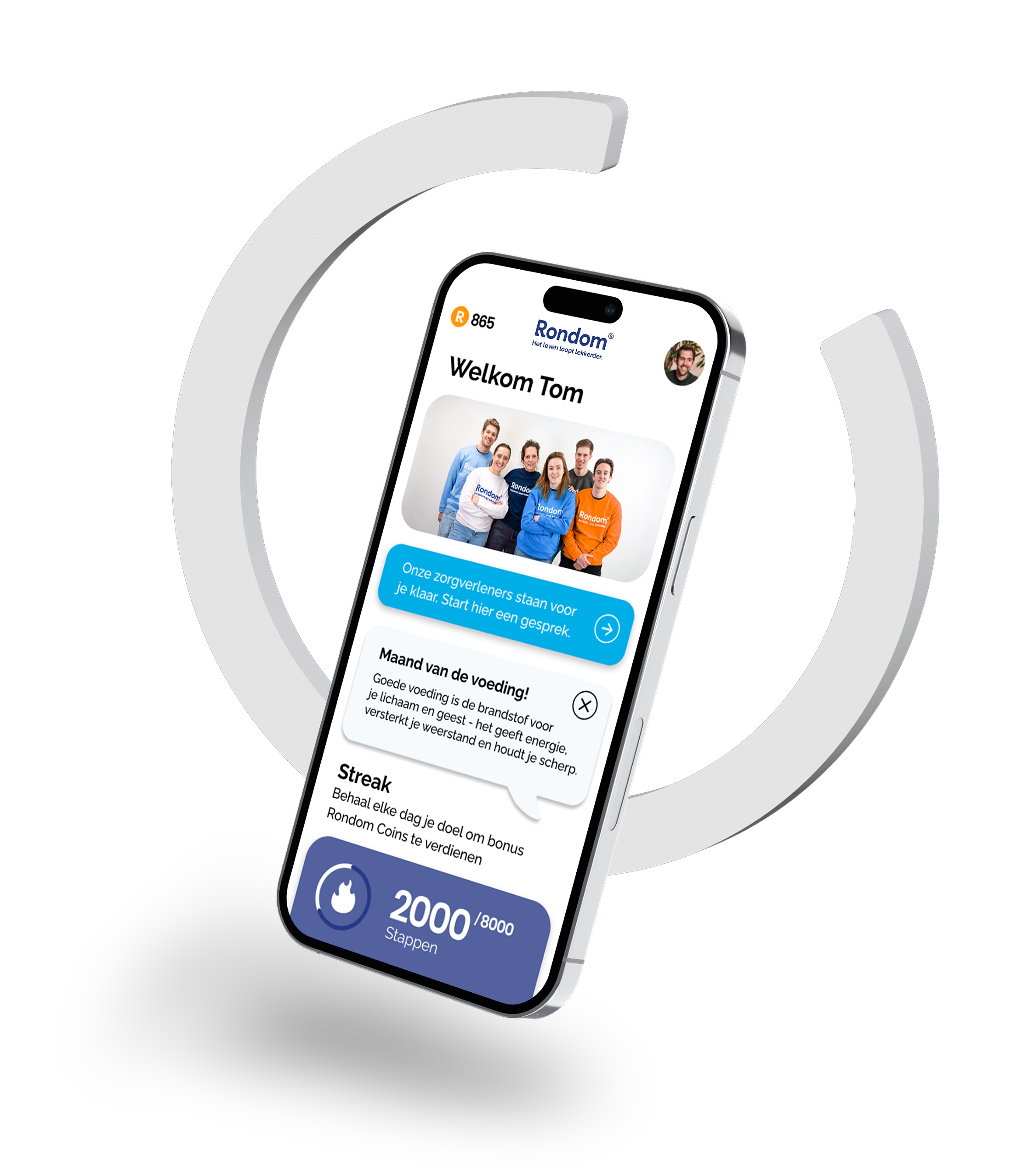
  • Work on your health with the Rondom app

    • Direct contact with healthcare professionals via chat
    • A community where you share experiences and motivate one another
    • Personal challenges that match your goals
    • Step counter for your daily exercise
    • Earn points for healthy choices
    • Articles, videos, recipes and assignments
    • Register for (online) events
    Discover the Rondom app

    Find a healthcare provider near you

    Book an appointmentCall usDownload the Rondom app