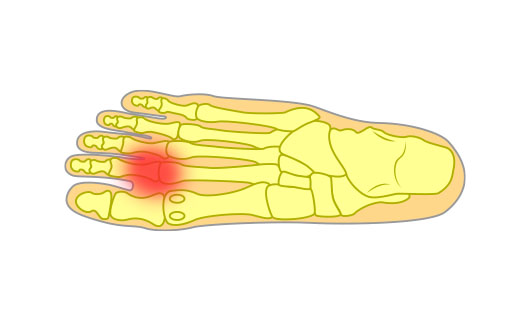
Freiberg’s disease / Morbus Köhler 2
Freiberg’s disease, also known as Morbus Köhler 2, Morbus Freiberg or ‘Köhler’s disease’, is a growth disorder affecting the second metatarsal bone. The condition usually develops in girls during puberty. The pain is usually felt under the ball of the foot.
What is Freiberg’s disease?
Freiberg’s disease, also known as Morbus Köhler 2, Morbus Freiberg or ‘Köhler’s disease’, is a growth disorder affecting the second metatarsal bone. The condition usually develops in girls during puberty. The pain is usually felt under the ball of the foot. Freiberg’s disease can lead to osteoporosis, making bone fractures more likely. The condition is therefore often only noticed once the metatarsal bone has fractured.
Morbus Köhler 1 Morbus Köhler 1 and 2 are similar conditions, but they affect different bones in the foot.
How does Freiberg’s disease develop?
The cause of Freiberg’s disease is often unknown. It is thought that poor blood circulation may be a possible cause; this would result in the bone receiving too little oxygen, leading to the death of bone cells. In addition, excessive strain on the foot may play a role.
Symptoms of Köhler’s disease 2
- Pain under the ball of the foot
- Pain when bending the foot whilst walking
- Swollen forefoot
- The joint of the affected metatarsal bone becomes stiffer
- Pain at rest
- Limping
- Pain may disappear for a while and then return
- Symptoms can become so severe that walking is almost impossible
Treatment by the podiatrist
Freiberg’s disease does not usually resolve on its own. Treatment by a podiatrist is aimed at relieving the pain, but not at curing the condition. Treatment may consist of:
- Arch supports: With arch supports It can relieve pressure on and support the affected joint. The orthotic can also help to make the rolling motion of the foot whilst walking (the roll-off phase) easier.
- Shoe advice: The shoe must have a removable insole so that the orthotic fits comfortably underneath the toes. Furthermore, the shoe should have a thick, preferably rigid sole.
- Orthosis: The silicone orthosis absorbs some of the pressure on the joint whilst walking.
- Stretching the Achilles tendon: For many patients, stretching the Achilles tendon through stretching exercises helps.