Heel pain
The calcaneus is a large, sturdy bone that plays a key role in standing and in the foot’s roll-off phase whilst walking. The calcaneus has direct joint contact with the talus, which forms an important part of the ankle joint. Damage to the joint between the calcaneus and the talus – known as the subtalar joint – leads to restricted movement of the foot whilst walking. The calcaneus also has an articular surface with one of the metatarsal bones and serves as an attachment point for a number of ankle ligaments and tendons in the foot.
Symptoms of heel pain:
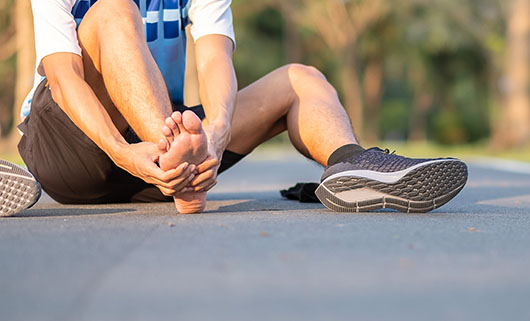
Complaints and injuries to the heel most commonly occur in two areas: pain at the back of the heel and pain on the underside of the heel. The complaints localised on the underside of the heel will be discussed in more detail.
- Calcaneodynia The fat pad located under the heel provides good cushioning whilst standing and walking. However, as we get older, this fat pad loses some of its function. This means that the fat pad becomes thinner and its shock-absorbing capacity decreases, which can lead to the heel bone becoming overloaded or irritated.
- Heel spur A heel spur, also known as plantar fasciitis, is an irritation or inflammation of the plantar fascia under the foot. This inflammation often arises as a result of several factors. The main factor is a change in the foot’s gait caused by postural abnormalities. In addition, wearing unsuitable shoes with soles that are too soft or too flexible, being overweight and overuse can all play a part. Read more.
- Tendon plate irritation/strain The plantar fascia plays a key role in the foot’s roll-off motion and is subjected to considerable strain. Overuse of the plantar fascia (plantar fasciitis/fasciosis) is usually caused by excessive tensile force at the point where the plantar fascia attaches to the sole of the foot.Read more.
Heel pain and podiatry
Examination must determine whether the heel bone is misaligned or bearing weight incorrectly, as this affects not only the heel bone itself and the surrounding tendons but also the rest of the foot. In addition, it will be investigated whether the condition is a heel spur, tendinitis or a combination of both. For both conditions, it is important to support the foot to prevent overstretching.
A good, sturdy shoe, with or without a corrective insole, is essential. In addition, for a genuine heel spur, it is important to relieve pressure on the site of the bony growth by creating a recess in the sole at the point of pain. In the case of tendinitis, a podiatrist can provide immediate relief by applying a tape that reduces the tension in the tendon.
If the symptoms are caused by incorrect foot position, gait or strain on the foot, a podiatrist can offer various treatment options. These include (sport)insoles, footwear advice, temporary relief (tape (and/or sole) in combination with physiotherapy, other orthoses and walking advice. In persistent cases, however, an injection or surgery is necessary.
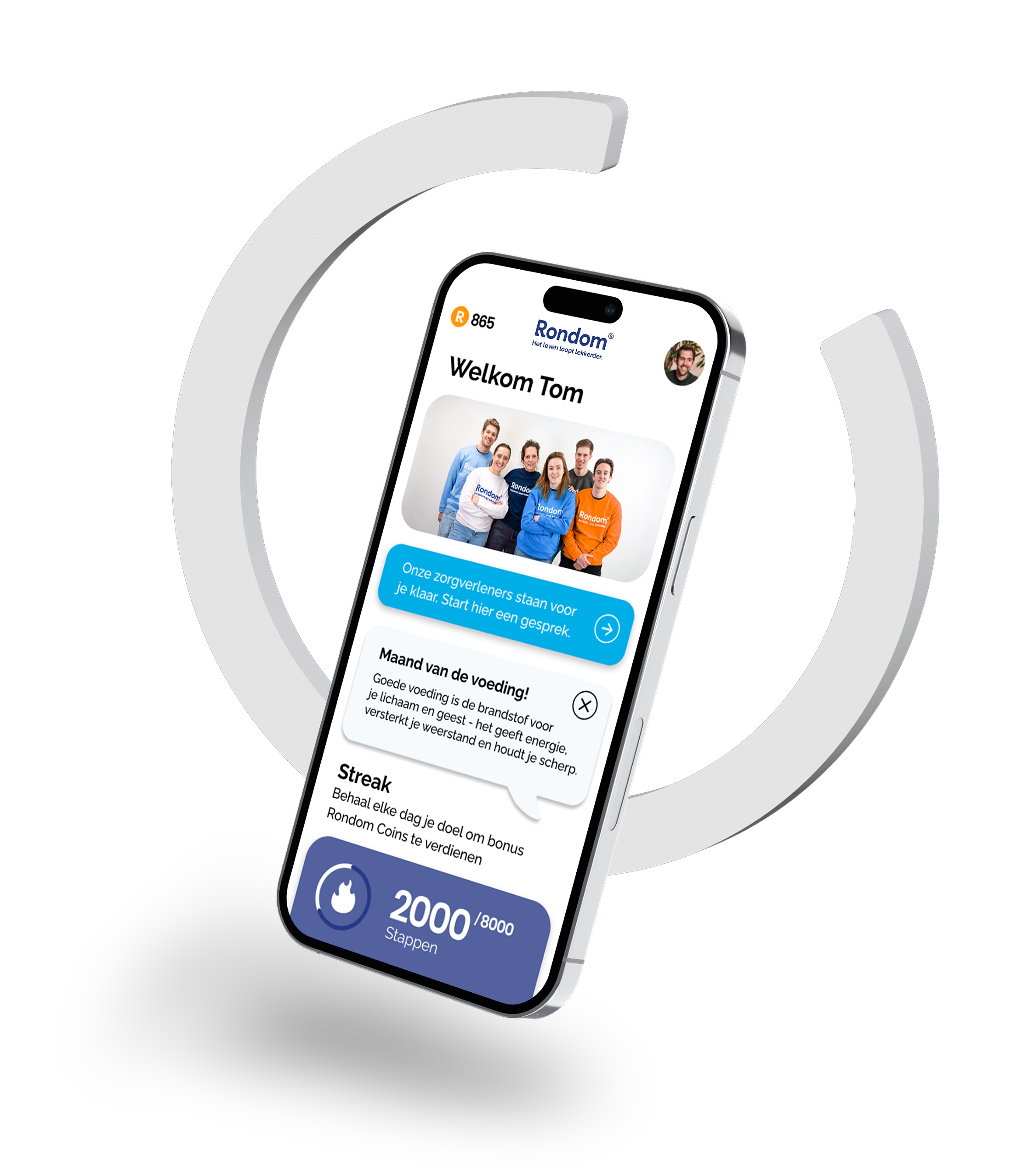
Work on your health with the Rondom app
- Direct contact with healthcare professionals via chat
- A community where you share experiences and motivate one another
- Personal challenges that match your goals
- Step counter for your daily exercise
- Earn points for healthy choices
- Articles, videos, recipes and assignments
- Register for (online) events