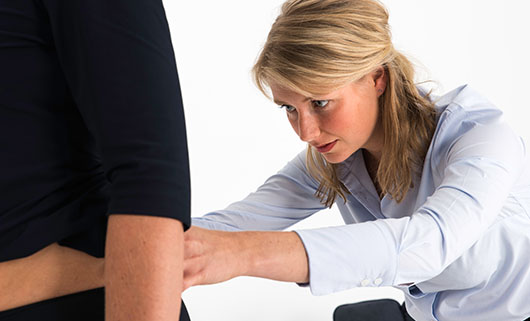
Lower back pain
Lower back pain is pain in the lower back and/or the pelvis.
What is lower back pain?
Lower back pain is characterised by pain in the lower back and/or the pelvis. When we look at the spine from the side, we can see that it naturally has curves. When these curves become too pronounced, we refer to this as postural abnormalities. For example, a pronounced hollow back is often seen in people with weak abdominal muscles, or during pregnancy. Lower back pain is unpleasant, but is usually not caused by anything serious. Not even if the pain is severe. It almost always goes away on its own. Gradually, the discomfort will ease and, after a while, you’ll be able to move without pain again. For some people, the pain goes away within a few days; for others, it may take a couple of weeks.
Causes of lower back pain
It is not always clear what causes someone to develop back pain, but lower back pain is usually caused by overloading the back and the sacroiliac joints. Examples include: poor posture, lifting too quickly or too heavily, or making a sudden, awkward movement (lumbago), poor physical fitness, spending a lot of time driving and feeling stressed, working for long periods in the same position, incorrect foot positioning, leg length discrepancy and congenital abnormalities. If one or both sacroiliac joints are stiff, this causes significant difficulties with walking, sitting, bending over, standing, etc. It may be that several causes are at play simultaneously. Or that, as a result of other symptoms elsewhere in the body, an incorrect walking or weight-bearing pattern develops.
Complaints
- Back pain can develop gradually or suddenly (lumbago)
- It is usually accompanied by stiffness
- Sometimes the pain is constant
- The pain may also occur when you adopt a certain posture
- Coughing, sneezing and twisting your back usually make the pain worse.
Misalignment of the sacroiliac joints leads to poor posture. This can cause the following symptoms, for example:
- Pain in the legs, knees and feet
- Pain in the hips, buttocks and groins
- Pain between the shoulder blades
- Neck and Shoulder Pain
- Headache
Pelvic complaints
The pelvis lies next to the sacrum. The pelvis and the sacrum form the foundation for the entire spine. Between the sacrum and the pelvis lie two joints known as the SI joints. The SI joints are very important for sitting, standing, walking, turning, etc. A common complaint is pelvic obliquity.
Spit
Lumbago is often a sudden, severe pain in the lumbar region, at the lower back between the buttocks and the lower ribs, and is caused by strained muscles, muscle spasms or small tears in muscles and/or ligaments. These are usually the group of muscles surrounding the spine.
A treatment
The treatment involves checking for a difference in leg length and, if necessary, fitting a heel lift to compensate.
An abnormal position and/or function of the feet affects the position and function of the pelvis and the spine. Corrective podiatric insoles These may offer a solution. Even if you lack sufficient cushioning whilst walking, orthotic insoles may be a solution. In addition, you will be given advice on footwear.
The expected outcome is fair to good. If there is a difference in leg length, orthotic insoles must be worn on a permanent basis.