1. Home
  2. Healthy living and participation
  3. Stress prikkels en mentale belasting
  4. Overprikkeling

What do you think of our website?

We would love to hear what works well and what could be better. Your feedback helps us improve our website.

What would you like to give feedback on?

Read how we use feedback data.

Please note: Do not share medical details or a citizen service number (BSN).

Rondom – Het leven loopt lekkerder
Nederlands
  • Employers
  • Partners
  • Research
  • Working at
Rondom app
Ordering insolesAfspraak maken
Rondom – Het leven loopt lekkerder
Afspraak maken
Rondom – Het leven loopt lekkerder

We’d be happy to help you further.

  • info@rondomlopengroep.nl
  • 088-1180570

Need help?

  • Frequently Asked Questions
  • Reimbursement
  • Complaints procedure
  • What does your health insurer cover?

Contact

  • Book an appointment

Need help?

  • Frequently Asked Questions
  • Reimbursement
  • Complaints procedure
  • What does your health insurer cover?

Contact

  • Book an appointment

Services

  • Occupational therapy
  • Lifestyle and Dietetics
  • Podiatry and chiropody care
  • Psychology and social work
  • Physiotherapy
  • Rondom in Business
  • Rondom Shoes

Discover Rondom

  • Healthy living and participation
  • Activities
  • Rondom app
  • Social impact
  • Research

About Rondom

  • Current
  • Find a location near you

Follow Rondom

LinkedInInstagramFacebook

Life runs more smoothly.

General (payment) terms and conditionsPrivacy StatementCookie Policy
  • What do you notice?
  • What might be the reason for this?
  • What can you do yourself?
  • When is it advisable to seek help?
  • How Rondom can help
  • Download the Rondom app
  • Make an appointment

Overstimulation

Do you find that noise, light, crowds or a lot of information quickly become too much for you? Perhaps you find it harder to cope with a crowded shop or a busy workplace. Overlapping conversations or notifications on your phone can also be stimulating. Whereas you used to be able to carry on as normal, it now feels as though your head is filling up. Overstimulation can have a significant impact on your daily life. You might start avoiding busy places, cancel social engagements or need a lot of time to recover after an ordinary day. That’s not unusual. If your mind or body has to process too many stimuli, the system becomes overloaded more quickly.

What do you notice?

Overstimulation can manifest itself physically, mentally and emotionally.

You may, for example, notice that:

  • sounds come through louder;
  • bright light or busy images can be tiring;
  • it is difficult to follow conversations;
  • you get irritated more easily;
  • you get a headache;
  • you get tired of the hustle and bustle;
  • if you wish to withdraw;
  • you find it difficult to concentrate;
  • you need a long time to recover after social activities.

Sometimes you only realise afterwards that it was all a bit too much. You come home feeling drained, tense or emotional. That can be confusing, especially when others don’t realise just how many stimuli you’re processing.

What might be the reason for this?

Overstimulation can be caused by stress, tiredness, pain, poor sleep or recovery from illness. Even after a burnout, concussion or a period of high stress, stimuli may be perceived more intensely than usual.

People also differ in how they experience and process stimuli. Whilst some are hardly bothered by crowds, noise or bright light, others are more sensitive to these things. This varies from person to person.

The environment also plays a major role. Think of a busy workplace, social activities, screens, notifications or constantly having to switch between different tasks.

If you have little time to recover, it becomes more difficult to process stimuli. Then something that normally goes well can suddenly become too much.

What can you do yourself?

It helps to manage stimuli more effectively. Not by avoiding everything, but by making conscious choices.

For example, you could:

  • visiting busy places at quiet times;
  • taking short breaks in a low-stimulus room;
  • turn off notifications on your phone;
  • shortening social appointments;
  • wear sunglasses or earplugs if that helps;
  • plan a recovery period after a busy period;
  • Alternate tasks involving lots of stimulation with quieter tasks;
  • clearly indicate when something becomes excessive.

Try to identify which triggers are the most difficult for you. That way, you can make more targeted adjustments.

When is it advisable to seek help?

It is wise to seek help if sensory overload is affecting your work, studies, social life or daily tasks. It is also a good idea to seek advice if you find yourself avoiding more and more situations or need a lot of time to recover.

Contact your GP if you suddenly experience overstimulation following a fall, accident or illness. You should also do so if your symptoms worsen rapidly or are accompanied by severe headaches, confusion or loss of function.

How Rondom can help

Together, we’ll look at which triggers are causing you stress and how you can organise your day more effectively. In doing so, we’ll focus on work, home, social activities, recovery and energy levels.

A occupational therapist helps you understand which stimuli affect your daily life. Together, you look for ways to cope better with these stimuli and to keep up with your activities. A lifestyle coach can help with sleep, recovery and moments of rest. In cases of anxiety, stress or difficulty in coming to terms with something, it can psychological support should be appropriate.

We are looking for a way for you to continue participating without becoming constantly overwhelmed.
Related topics

  • Emotional strain caused by physical symptoms

    Do you find that your symptoms are not only physically taxing, but also take a heavy emotional toll on you? Perhaps you feel sad, angry or frustrated because things no longer come naturally. Or you may feel insecure about your body, your future or what others expect of you. Physical symptoms often affect more areas than just the place where you feel pain or have a limitation. They can impact your work, family, social life, sleep and self-image. This can be emotionally draining. It’s only natural that you don’t always remain strong or positive in the face of this.

  • Lower self-confidence

Was this information helpful?

Have you noticed that your self-confidence has waned? Perhaps you find yourself doubting yourself, your body or what you are capable of more often. Things that used to come naturally now feel stressful or uncertain. This can have a significant impact on your work, social life, relationships and day-to-day choices. A loss of self-confidence rarely happens overnight. It develops gradually when you experience difficulties, find yourself stuck more often, or realise you can no longer do everything as you used to. This can be painful, especially if you are used to being independent, active or caring.

  • Panic or anxiety

    Do you ever experience a sudden wave of panic or anxiety? Perhaps your heart is racing, you’re finding it harder to breathe, or it feels as though you’re losing control. This can be very frightening, especially if you don’t fully understand what’s happening. Panic or anxiety can arise suddenly, but it can also build up gradually. Sometimes panic occurs in busy or stressful situations. Sometimes your body reacts as if there is danger, even though there isn’t any immediate danger. It’s important to take these symptoms seriously, without immediately assuming that there is something wrong with you. Many people experience panic or severe anxiety at some point in their lives.

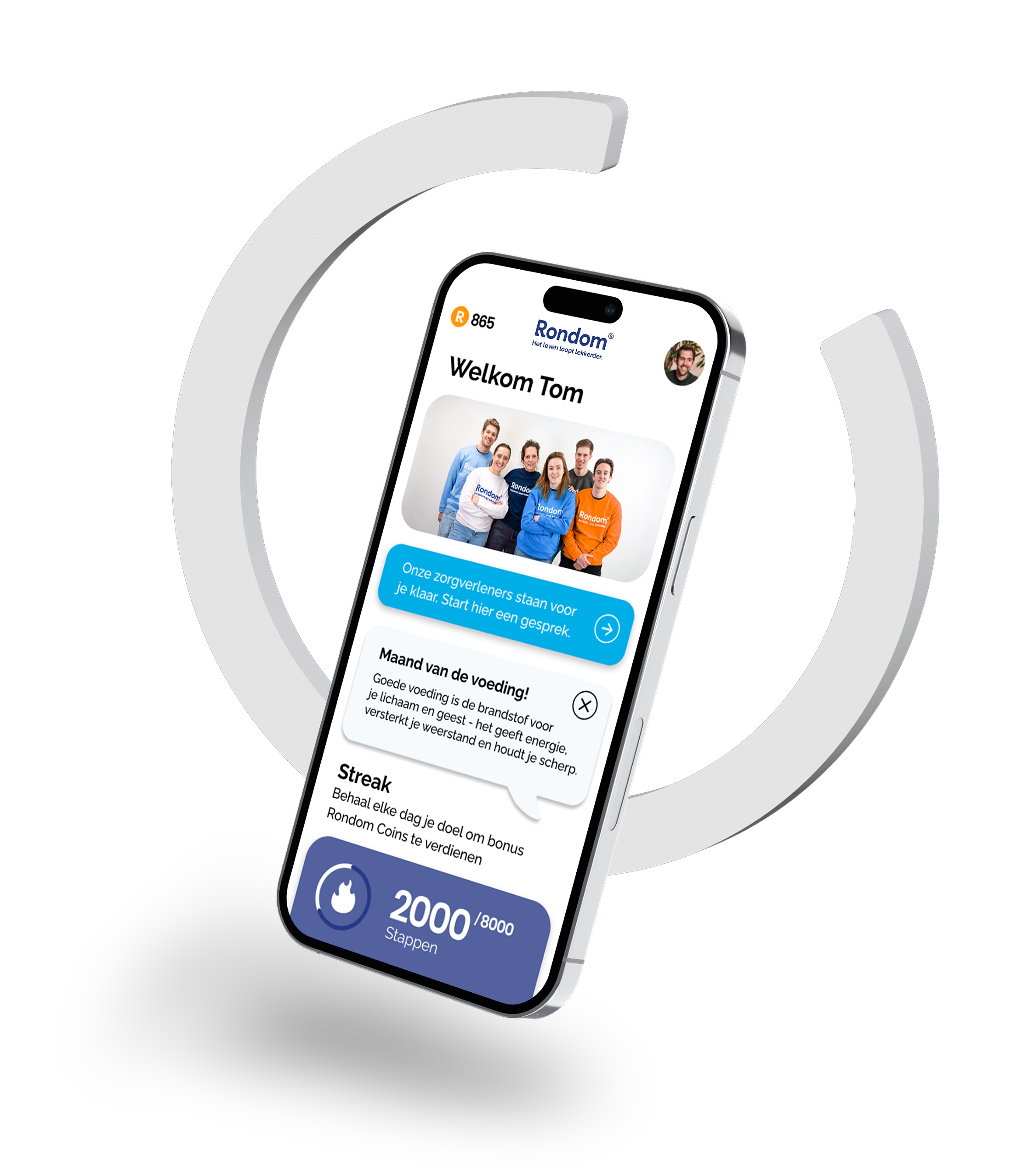
  • Work on your health with the Rondom app

    • Direct contact with healthcare professionals via chat
    • A community where you share experiences and motivate one another
    • Personal challenges that match your goals
    • Step counter for your daily exercise
    • Earn points for healthy choices
    • Articles, videos, recipes and assignments
    • Register for (online) events
    Discover the Rondom app

    Find a healthcare provider near you

    Book an appointmentCall usDownload the Rondom app