1. Home
  2. Healthy living and participation
  3. Gezonde gewoontes
  4. Terugval

What do you think of our website?

We would love to hear what works well and what could be better. Your feedback helps us improve our website.

What would you like to give feedback on?

Read how we use feedback data.

Please note: Do not share medical details or a citizen service number (BSN).

Rondom – Het leven loopt lekkerder
Nederlands
  • Employers
  • Partners
  • Research
  • Working at
Rondom app
Ordering insolesAfspraak maken
Rondom – Het leven loopt lekkerder
Afspraak maken
Rondom – Het leven loopt lekkerder

We’d be happy to help you further.

  • info@rondomlopengroep.nl
  • 088-1180570

Need help?

  • Frequently Asked Questions
  • Reimbursement
  • Complaints procedure
  • What does your health insurer cover?

Contact

  • Book an appointment

Need help?

  • Frequently Asked Questions
  • Reimbursement
  • Complaints procedure
  • What does your health insurer cover?

Contact

  • Book an appointment

Services

  • Occupational therapy
  • Lifestyle and Dietetics
  • Podiatry and chiropody care
  • Psychology and social work
  • Physiotherapy
  • Rondom in Business
  • Rondom Shoes

Discover Rondom

  • Healthy living and participation
  • Activities
  • Rondom app
  • Social impact
  • Research

About Rondom

  • Current
  • Find a location near you

Follow Rondom

LinkedInInstagramFacebook

Life runs more smoothly.

General (payment) terms and conditionsPrivacy StatementCookie Policy
  • What do you notice?
  • What could be causing this?
  • What can you do yourself?
  • When is it advisable to seek help?
  • How Rondom can help
  • Download the Rondom app
  • Make an appointment

Relapse

Have you slipped back into an old habit and are you fed up with it? Perhaps you’ve started eating more again, exercising less, smoking again or drinking alcohol more often. A relapse can feel like a failure. But relapses are often part and parcel of behavioural change. It doesn’t mean you’re starting from scratch all over again. The most important thing is how you deal with a relapse. If you’re too hard on yourself, you’re more likely to give up trying altogether. If you use a relapse as a learning experience, you can discover what you need during difficult moments.

What do you notice?

Relapse can occur in various ways. Sometimes suddenly. Sometimes gradually.

You may, for example, notice that:

  • old habits resurface;
  • You think it’s pointless anyway;
  • if you feel ashamed or guilty;
  • you put off making healthy choices;
  • you have less structure;
  • you didn’t see those difficult moments coming;
  • avoids your support;
  • you’ll end up thinking it’s all or nothing;
  • you lose your motivation.

Sometimes, just one difficult moment is enough to make you think that everything has gone wrong. But that’s not true. You can always get back on track.

What could be causing this?

Relapses often occur during times of stress, tiredness, public holidays, holidays, illness, grief or when life gets hectic. It is precisely at times when life takes a different turn that people fall back on familiar patterns.

Even overly strict targets can lead to a relapse. If a plan leaves little room for ordinary days and difficult days, it is hard to stick to.

In addition, a lack of support may be a factor. Change is more difficult if you have to do it on your own or if those around you are not on board.

What can you do yourself?

It helps to look at relapses calmly rather than judging yourself.

For example, you could:

  • write down what happened before the relapse;
  • to see which moment was difficult;
  • Choose one small step to get started again;
  • ask for support;
  • to make your goal smaller;
  • preparing for difficult situations in advance;
  • don’t wait until Monday or the start of a new month;
  • remind yourself of what you have already achieved.

A setback is a warning sign. It shows where your plan needs extra support.

When is it advisable to seek help?

It is wise to seek help if you keep relapsing and do not know why. Support can also help if a relapse causes a great deal of shame, low mood or stress.

Be sure to seek help if you experience a relapse into smoking, vaping, heavy alcohol consumption or eating habits that you cannot control. Your GP can then advise you.

How Rondom can help

Together, we’ll look at your relapse without judgement. In doing so, we’ll focus on stress, sleep, social situations, emotions, habits and support.

A lifestyle coach can help you draw up a relapse prevention plan and get back into new habits. Psychological Support may be appropriate for issues such as shame, low mood, emotional eating or addictive behaviours. A occupational therapist can help if planning, energy levels or daily routine are factors.

Together, we are looking for a way to use setbacks as learning opportunities and to move forward again.
Related topics

  • Alcohol consumption

    Are you wondering whether you’d like to drink less alcohol? Perhaps you drink more often than you intended. Or you’ve noticed that alcohol has become a regular way to unwind after a busy day. Many people drink out of habit, for social reasons or to cope with stress. Yet alcohol can affect your sleep, energy levels, mood and health. Drinking less doesn’t have to start with a big decision. Sometimes it helps simply to take an honest look at when you drink, why you drink and what you get out of it. Without judgement. The aim isn’t to criticise yourself, but to gain more control.

  • Building up fitness

Was this information helpful?

Would you like to build up your fitness, but aren’t quite sure how to start? Perhaps you get tired more quickly than you used to, find yourself out of breath when climbing stairs, or feel unsteady after a period of inactivity. It can be frustrating when your body no longer performs as it used to. Building up your fitness takes time. It’s not about doing as much as possible as quickly as possible, but about exercising regularly at a level that suits your capacity. Starting too intensely can lead to discomfort or a relapse. Staying too cautious can mean your fitness doesn’t improve. The trick is to build it up gradually.

  • Dietary pattern

    Would you like to eat more healthily, but aren’t quite sure where to start? Perhaps you’ve read so much conflicting advice that you’ve actually lost your way. Or maybe you do know what’s healthy, but you can’t seem to stick to it during your busy week. A healthy diet doesn’t have to be perfect. Above all, it needs to fit in with your life. Diet affects your energy levels, weight, recovery, blood pressure, cholesterol and how you feel. Yet eating healthily isn’t just about knowledge. It’s also about planning, shopping, habits, taste, emotions and time.

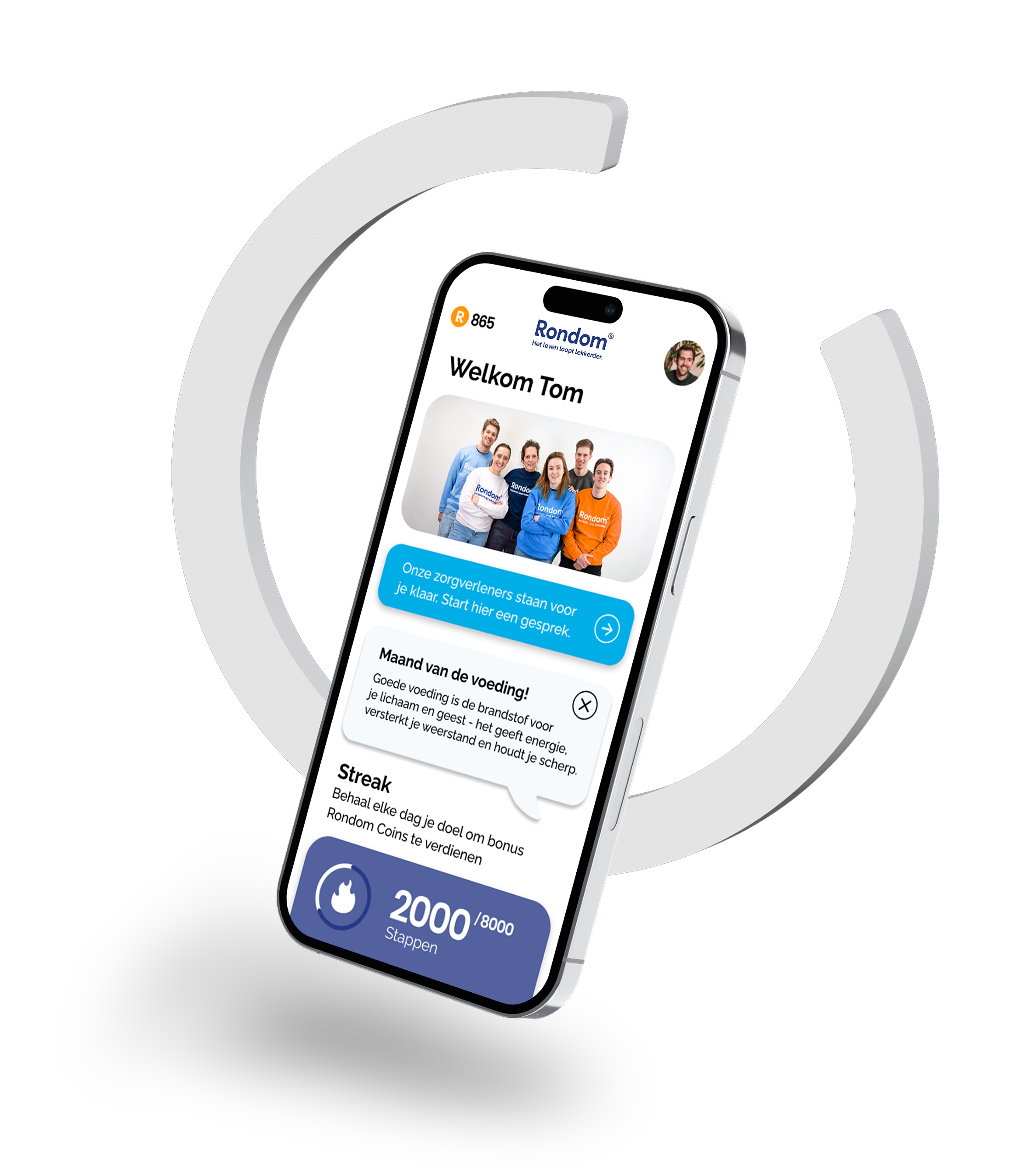
  • Work on your health with the Rondom app

    • Direct contact with healthcare professionals via chat
    • A community where you share experiences and motivate one another
    • Personal challenges that match your goals
    • Step counter for your daily exercise
    • Earn points for healthy choices
    • Articles, videos, recipes and assignments
    • Register for (online) events
    Discover the Rondom app

    Find a healthcare provider near you

    Book an appointmentCall usDownload the Rondom app