1. Home
  2. Healthy living and participation
  3. Gezonde gewoontes
  4. Nee zeggen

What do you think of our website?

We would love to hear what works well and what could be better. Your feedback helps us improve our website.

What would you like to give feedback on?

Read how we use feedback data.

Please note: Do not share medical details or a citizen service number (BSN).

Rondom – Het leven loopt lekkerder
Nederlands
  • Employers
  • Partners
  • Research
  • Working at
Rondom app
Ordering insolesAfspraak maken
Rondom – Het leven loopt lekkerder
Afspraak maken
Rondom – Het leven loopt lekkerder

We’d be happy to help you further.

  • info@rondomlopengroep.nl
  • 088-1180570

Need help?

  • Frequently Asked Questions
  • Reimbursement
  • Complaints procedure
  • What does your health insurer cover?

Contact

  • Book an appointment

Need help?

  • Frequently Asked Questions
  • Reimbursement
  • Complaints procedure
  • What does your health insurer cover?

Contact

  • Book an appointment

Services

  • Occupational therapy
  • Lifestyle and Dietetics
  • Podiatry and chiropody care
  • Psychology and social work
  • Physiotherapy
  • Rondom in Business
  • Rondom Shoes

Discover Rondom

  • Healthy living and participation
  • Activities
  • Rondom app
  • Social impact
  • Research

About Rondom

  • Current
  • Find a location near you

Follow Rondom

LinkedInInstagramFacebook

Life runs more smoothly.

General (payment) terms and conditionsPrivacy StatementCookie Policy
  • What do you notice?
  • What might be the reason for this?
  • What can you do yourself?
  • When is it advisable to seek help?
  • How Rondom can help
  • Download the Rondom app
  • Make an appointment

Saying ‘no’

Do you find it difficult to say no? Perhaps you say yes to food, alcohol, extra work, social pressure or tasks set by others, even though you actually want something else. Saying no can feel uncomfortable. You don’t want to be unfriendly, disappoint someone or have to explain yourself. Yet saying ‘no’ is important for healthy habits. It helps to protect your choices. Not out of strictness, but based on what you need to look after yourself properly. A clear ‘no’ can make room for a better ‘yes’.

What do you notice?

Finding it difficult to say ‘no’ can lead to you pushing yourself beyond your limits more often.

You may, for example, notice that:

  • you say ‘yes’ to avoid any inconvenience;
  • you end up regretting your choice;
  • you eat or drink because others insist;
  • you take on extra tasks whilst you are tired;
  • you have little time left for yourself;
  • you feel guilty when you say no;
  • you’re worried about reactions;
  • if you abandon your own plan;
  • you are then hard on yourself.

Sometimes it is not the temptation itself that is the hardest part, but the social situation surrounding it.

What might be the reason for this?

Saying ‘no’ can be difficult due to habit, insecurity or a desire for harmony. Perhaps you are used to putting others first and only then thinking of yourself.

Social pressure also plays a part. When it comes to food, alcohol or smoking, saying ‘no’ can invite questions. That makes it easier to go along with it after all.

In addition, tiredness can have an impact. If you are tired, it is more difficult to make conscious choices and stick to your limits.

What can you do yourself?

It helps to think about what you want to say in advance. That way, you won’t have to search for words as much when the time comes.

For example, you could:

  • use a short standard sentence;
  • to say ‘no’ without going into detail;
  • to propose an alternative;
  • think in advance about what you do want;
  • practising with simple situations;
  • seek support from someone who understands your choice;
  • to distance oneself from busy or tempting moments;
  • remind yourself why your choice is important.

Saying ‘no’ doesn’t have to be harsh. You can be both polite and clear.

When is it advisable to seek help?

Seeking help is advisable if your difficulty in saying ‘no’ means you keep making choices you do not agree with. Counselling can also help if feelings of guilt, social pressure or fear of rejection are having a significant impact.

Ask for help if saying ‘no’ is important for your health – for example, when it comes to alcohol, smoking, overwork or eating habits – but you keep finding it difficult to do so.

How Rondom can help

Together, we’ll look at the situations in which saying ‘no’ is difficult and what you need to make clearer choices. In doing so, we’ll focus on habits, social pressure, boundaries, stress and self-confidence.

A lifestyle coach can help you make and stick to healthy choices. Psychological Support can help with feelings of guilt, uncertainty or fear of reactions. A occupational therapist can help think things through when saying ‘no’ is about tasks, energy and being overworked.

Together, we’ll look for ways to make choices that suit you.
Related topics

  • Alcohol consumption

    Are you wondering whether you’d like to drink less alcohol? Perhaps you drink more often than you intended. Or you’ve noticed that alcohol has become a regular way to unwind after a busy day. Many people drink out of habit, for social reasons or to cope with stress. Yet alcohol can affect your sleep, energy levels, mood and health. Drinking less doesn’t have to start with a big decision. Sometimes it helps simply to take an honest look at when you drink, why you drink and what you get out of it. Without judgement. The aim isn’t to criticise yourself, but to gain more control.

  • Building up fitness

Was this information helpful?

Would you like to build up your fitness, but aren’t quite sure how to start? Perhaps you get tired more quickly than you used to, find yourself out of breath when climbing stairs, or feel unsteady after a period of inactivity. It can be frustrating when your body no longer performs as it used to. Building up your fitness takes time. It’s not about doing as much as possible as quickly as possible, but about exercising regularly at a level that suits your capacity. Starting too intensely can lead to discomfort or a relapse. Staying too cautious can mean your fitness doesn’t improve. The trick is to build it up gradually.

  • Dietary pattern

    Would you like to eat more healthily, but aren’t quite sure where to start? Perhaps you’ve read so much conflicting advice that you’ve actually lost your way. Or maybe you do know what’s healthy, but you can’t seem to stick to it during your busy week. A healthy diet doesn’t have to be perfect. Above all, it needs to fit in with your life. Diet affects your energy levels, weight, recovery, blood pressure, cholesterol and how you feel. Yet eating healthily isn’t just about knowledge. It’s also about planning, shopping, habits, taste, emotions and time.

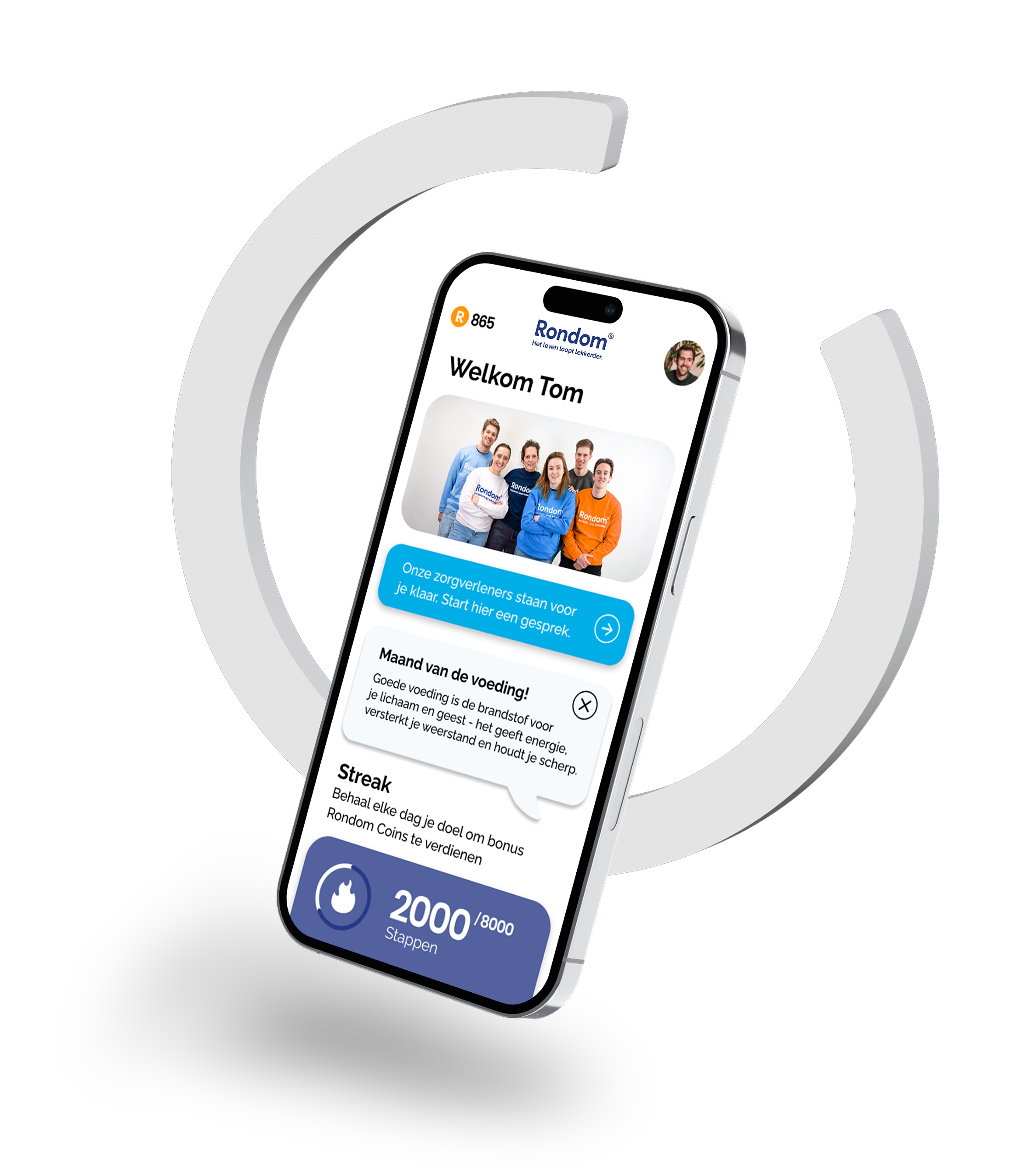
  • Work on your health with the Rondom app

    • Direct contact with healthcare professionals via chat
    • A community where you share experiences and motivate one another
    • Personal challenges that match your goals
    • Step counter for your daily exercise
    • Earn points for healthy choices
    • Articles, videos, recipes and assignments
    • Register for (online) events
    Discover the Rondom app

    Find a healthcare provider near you

    Book an appointmentCall usDownload the Rondom app