1. Home
  2. Healthy living and participation
  3. Gezonde gewoontes
  4. Emotie eten

What do you think of our website?

We would love to hear what works well and what could be better. Your feedback helps us improve our website.

What would you like to give feedback on?

Read how we use feedback data.

Please note: Do not share medical details or a citizen service number (BSN).

Rondom – Het leven loopt lekkerder
Nederlands
  • Employers
  • Partners
  • Research
  • Working at
Rondom app
Ordering insolesAfspraak maken
Rondom – Het leven loopt lekkerder
Afspraak maken
Rondom – Het leven loopt lekkerder

We’d be happy to help you further.

  • info@rondomlopengroep.nl
  • 088-1180570

Need help?

  • Frequently Asked Questions
  • Reimbursement
  • Complaints procedure
  • What does your health insurer cover?

Contact

  • Book an appointment

Need help?

  • Frequently Asked Questions
  • Reimbursement
  • Complaints procedure
  • What does your health insurer cover?

Contact

  • Book an appointment

Services

  • Occupational therapy
  • Lifestyle and Dietetics
  • Podiatry and chiropody care
  • Psychology and social work
  • Physiotherapy
  • Rondom in Business
  • Rondom Shoes

Discover Rondom

  • Healthy living and participation
  • Activities
  • Rondom app
  • Social impact
  • Research

About Rondom

  • Current
  • Find a location near you

Follow Rondom

LinkedInInstagramFacebook

Life runs more smoothly.

General (payment) terms and conditionsPrivacy StatementCookie Policy
  • What do you notice?
  • What might be the reason for this?
  • What can you do yourself?
  • When is it advisable to seek help?
  • How Rondom can help
  • Download the Rondom app
  • Make an appointment

Emotional eating

Do you find that you eat when you are tired, sad, angry, tense or restless? Perhaps you turn to food after a busy day or at times when you feel empty. Emotional eating is very common. It is not a sign of a lack of character. Eating can provide temporary comfort, calm or distraction. The problem is that emotional eating often triggers other feelings afterwards – such as guilt, shame or disappointment. This can lead to renewed stress, and eating then becomes a way of coping with it again. This can create a cycle that is difficult to break.

What do you notice?

Emotional eating varies from person to person. Sometimes it involves eating a lot. Sometimes it involves constantly eating small amounts between meals.

You may, for example, notice that:

  • you eat without actually being hungry;
  • especially when you feel the urge to eat due to stress or sadness;
  • you find it hard to stop once you’ve started;
  • whether you prefer sweet, savoury or fatty food;
  • you feel guilty afterwards;
  • you use food as a reward;
  • you eat in secret;
  • you are strict with yourself after eating;
  • you keep making New Year’s resolutions time and time again.

Sometimes, eating can feel like a way of regaining control. But afterwards, you may feel that you have actually lost control.

What might be the reason for this?

Emotional eating can arise when food becomes associated with comfort, calm or reward. That is understandable. Food is close at hand, readily available and quickly makes you feel good.

Stress, poor sleep and tiredness make it harder to make conscious choices. Your body then craves a quick energy boost more readily.

Even strict dieting can exacerbate emotional eating. If you impose too many restrictions, the urge can sometimes become stronger. Then, giving in just once feels like a failure, which perpetuates the pattern.

What can you do yourself?

It helps to look at the moment before eating. Not to judge yourself, but to understand the pattern.

For example, you could:

  • write down when you eat out of emotion;
  • ask yourself whether you are hungry or need something else;
  • providing regular meals;
  • do not skip meals;
  • find another way to reduce stress;
  • do not categorise food as good or bad;
  • eat small portions and be mindful of what you eat;
  • remain calm after a difficult moment.

Don’t try to change everything at once. Recognising just one pattern is already an important step.

When is it advisable to seek help?

It is wise to seek help if emotional eating has a significant impact on your weight, mood or self-image. It is also a good idea to seek advice if you experience binge eating, feel ashamed or feel that food dictates your day.

Please contact your GP if you feel you are losing control over your eating or if your eating behaviour is making you feel down.

How Rondom can help

Together, we’ll look at which emotions, situations and habits influence your eating behaviour. In doing so, we’ll focus on stress, sleep, routine, self-image and achievable choices.

A lifestyle coach can help to bring more structure to eating and recovery. In cases of shame, binge eating, stress or negative thoughts, it can psychological support should be appropriate. A occupational therapist can help if planning, energy levels or daily routine affect eating habits.

Together, we’ll look for a non-judgemental approach, with steps that you can actually stick to.
Related topics

  • Alcohol consumption

    Are you wondering whether you’d like to drink less alcohol? Perhaps you drink more often than you intended. Or you’ve noticed that alcohol has become a regular way to unwind after a busy day. Many people drink out of habit, for social reasons or to cope with stress. Yet alcohol can affect your sleep, energy levels, mood and health. Drinking less doesn’t have to start with a big decision. Sometimes it helps simply to take an honest look at when you drink, why you drink and what you get out of it. Without judgement. The aim isn’t to criticise yourself, but to gain more control.

  • Building up fitness

Was this information helpful?

Would you like to build up your fitness, but aren’t quite sure how to start? Perhaps you get tired more quickly than you used to, find yourself out of breath when climbing stairs, or feel unsteady after a period of inactivity. It can be frustrating when your body no longer performs as it used to. Building up your fitness takes time. It’s not about doing as much as possible as quickly as possible, but about exercising regularly at a level that suits your capacity. Starting too intensely can lead to discomfort or a relapse. Staying too cautious can mean your fitness doesn’t improve. The trick is to build it up gradually.

  • Dietary pattern

    Would you like to eat more healthily, but aren’t quite sure where to start? Perhaps you’ve read so much conflicting advice that you’ve actually lost your way. Or maybe you do know what’s healthy, but you can’t seem to stick to it during your busy week. A healthy diet doesn’t have to be perfect. Above all, it needs to fit in with your life. Diet affects your energy levels, weight, recovery, blood pressure, cholesterol and how you feel. Yet eating healthily isn’t just about knowledge. It’s also about planning, shopping, habits, taste, emotions and time.

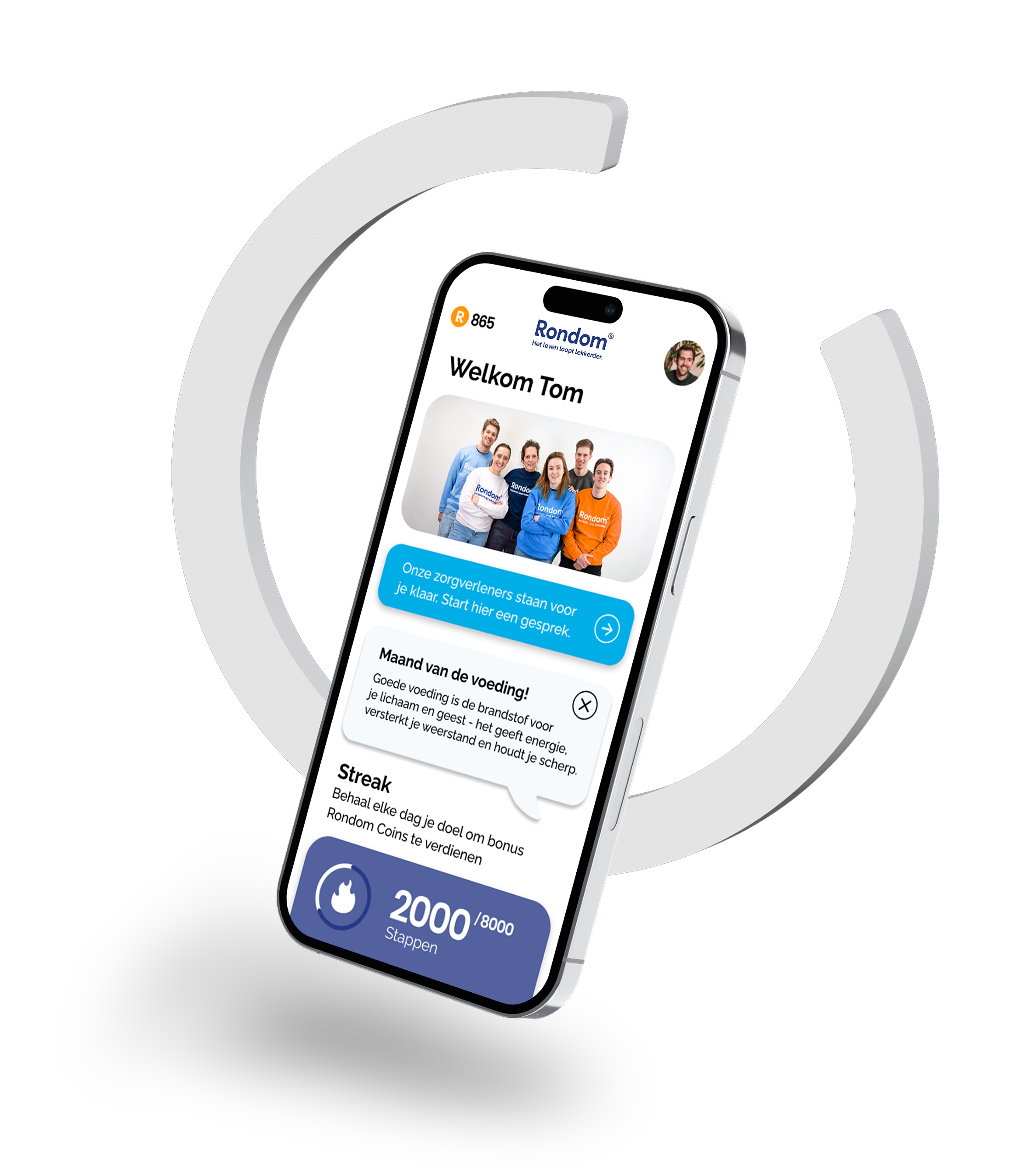
  • Work on your health with the Rondom app

    • Direct contact with healthcare professionals via chat
    • A community where you share experiences and motivate one another
    • Personal challenges that match your goals
    • Step counter for your daily exercise
    • Earn points for healthy choices
    • Articles, videos, recipes and assignments
    • Register for (online) events
    Discover the Rondom app

    Find a healthcare provider near you

    Book an appointmentCall usDownload the Rondom app