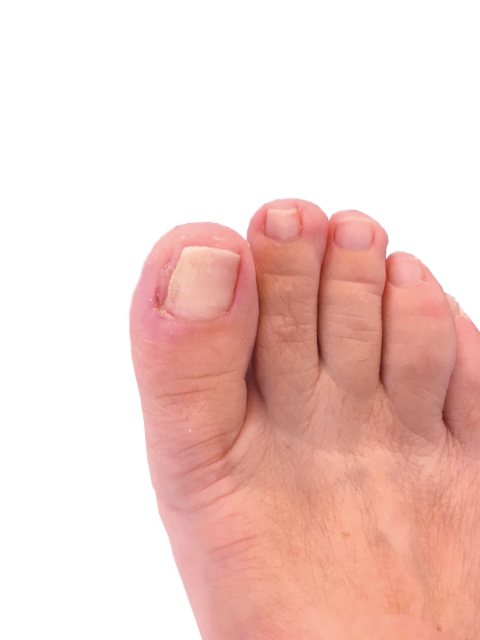
Treating an ingrown toenail | partial nail resection
A partial nail resection is a surgical procedure in which part of the ingrown toenail is removed under local anaesthetic. When an ingrown toenail can no longer be treated using conservative therapies such as instrumental foot treatment and/or a nail brace, a partial nail resection may be carried out by a GP or a podiatrist.
What is a partial nail resection?
A partial nail resection is a surgical procedure in which part of the ingrown nail is removed under local anaesthetic. ‘Partial’ means ‘in part’. And ‘resection’ means ‘removal’. In other words, a partial nail removal. A nail resection is chosen when an ingrown toenail can no longer be treated in any other way. The removal of the ingrown nail can be carried out by your GP or a podiatrist.
The podiatrists at our practice have completed additional training alongside their podiatry qualification, under the supervision of a doctor. The podiatrists have also gained sufficient practical experience through work placements. The podiatrists therefore know how to administer an anaesthetic and are able to carry out the treatment. The podiatrist will only perform a partial nail resection on the instructions of your GP.
When are you eligible?
- Recurrent ingrown toenail;
- If other treatments are no longer effective due to inflammation or if the toe is too painful;
- When the side of the nail cannot be reached due to the shape of the nail, or if the nail is too wide for the nail bed.
Reason for not carrying out the treatment
- Blood thinners* (INR must be below 2–3 on the day of treatment)
- Diabetes (HbA1c must have been tested less than three months ago and must be below 64 mmol/mol)
- Vitamin B12 and/or iron deficiency
- Hypersensitivity or allergy to lidocaine
- Peripheral arterial disease (ABPI <0.9)
- Cellulitis at the injection site
- Children under the age of 5
- Asthma not well controlled
- Chemotherapy
- Autoimmune disease
- Medicines that suppress the immune system (e.g. prednisone and various medicines for rheumatoid arthritis)
- Pregnancy
- Liver problems
- Myasthenia gravis
- Adam-Stokes syndrome
- AV block
- Recent heart attack
- Conditions that cause people to bleed easily (e.g. haemophilia)
* The treatment can be carried out in consultation with your GP.
Permission
The podiatrists at our practice frequently carry out partial nail resections, so they are very skilled at this. The treatment is low-risk. This means there is a low risk of side effects or complications.
However, the podiatrist must receive a referral from your GP in order to carry out the nail resection. This is necessary because administering anaesthesia (which ensures the treatment is pain-free) is a reserved procedure. This means that only GPs or medical specialists are permitted to carry out this treatment independently. Alternatively, they may delegate the treatment to a healthcare professional to carry out the procedure. For example, to a podiatrist.
When your GP instructs our podiatrist to carry out a resection, we know that we can treat you safely.
Treatment
The treatment takes about half an hour per toe. We’ll book an hour for you. You may take a paracetamol before the treatment. This may make the administration of the anaesthetic feel less painful. Once your doctor’s referral has been confirmed, the treatment will begin.
Anaesthesia: your toe will be disinfected and then numbed with two injections. Administering the injections takes approximately two 20-second intervals. These injections may be painful as they cause pressure to build up in the toe.
Treatment: the toe is tied off with an elastic band, temporarily cutting off the blood supply to your toe. The podiatrist can now treat you safely. Your nail is trimmed back to the cuticle and cut through to the nail root. The cut-away nail and excess tissue are then removed. Finally, phenol is dripped into the wound and massaged in for 2 minutes. Phenol ensures that a new nail cannot grow back.
Once the treatment is complete, the podiatrist applies an alginate gel (Flaminal Forte). The elastic band is then cut through. Blood can now flow to the toe again. The toe is bandaged with a pressure dressing.
After treatment
The anaesthetic will have worn off after about two hours. If you experience pain, you can take paracetamol: a maximum of 500 mg six times a day. The dosage for children may differ, so please read the medicine’s package leaflet.
After the treatment, you must not drive a vehicle yourself. We recommend that you wear open-toed shoes after your treatment. For the first two days following the procedure, it is best to keep your leg elevated and use it as little as possible. This will prevent too much pressure being placed on your toe. Applying too much pressure to your toe too soon can cause pain.
The wound may continue to ooze fluid for up to 6 weeks after the procedure. As long as fluid is coming out of the wound, it is best not to go swimming or to the sauna. We also advise against foot baths. It is important that you keep the wound clean! The wound will only be fully healed once it has stopped oozing. As long as fluid is still coming from the wound, there is a risk of infection.
After 5 days, we will ask you by email to send a clear photo of your toe. This will enable the podiatrist to assess how the wound is healing. If the wound is healing well, an appointment will be booked with your podiatrist for 6 weeks’ time.
Aftercare
- After treatment, a pressure dressing will be applied to the toe. The pressure dressing may be removed after 2–3 days. In the event of severe pain, the dressing may be removed earlier. It is important to remove the dressing carefully. This reduces the risk of tearing open the wound. Is the dressing sticking to the wound? If so, wet the dressing and try again. The dressing comes away more easily when it is wet.
- We will provide you with an alginate gel (Flaminal Forte) to treat the wound. The alginate gel absorbs moisture and has antibacterial properties. This gel was also applied to the wound after the treatment. You should remove the gel after taking off the dressing by rinsing with (lukewarm) water and using a sterile gauze pad. Gently pat the wound area dry with a new sterile gauze pad. Apply the new alginate gel to the wound area daily after showering and drying. Stop using the alginate gel after one week; this may vary if the podiatrist advises otherwise during the weekly check-up.
- As long as there is wound exudate, the wound may be covered with a white plaster. However, try to let the wound air-dry as much as possible and wear open-toed shoes. This will help the wound heal more quickly.
Guidance
- To prevent stiffness in your toe, it is best to move your toe as much as possible;
- Infection: the GP can prescribe antibiotics if necessary;
- If the nail does grow back: contact your podiatrist;
- Complete detachment of the nail: the part of the nail that has not been treated with phenol simply grows back;
- Numbness in the toe: often in the first few days after the procedure.
When to get in touch
If you are in any doubt, have any questions, or if the nail does grow back, please contact us via nagelprobleem@rondompodotherapeuten.nl or on 088-1180500. You are always welcome to email a photo so that we can assess the toe. It is normal for the area around the cuticle to turn red, swell up and be sensitive for a while.