General back problems
Back pain is a broad term for pain or other discomfort in the back. A great many people suffer from back pain. Some people experience back pain for a short time, whilst others have chronic back pain. The back pain can be very severe and, for many people, is the reason they are no longer able to work. Click here for more information about lower back pain.
Causes of lower back pain
In most people with back pain, no clear cause can be identified. We refer to this as non-specific back pain. In particular, the lower back is a common condition, also known as lower back pain, lumbago or a back spasm. Factors that play a role in the development of this form of back pain include:
- Poor posture.
- Frequent or prolonged strain on the back
- Lifting too quickly or incorrectly
- Overweight
- Stress
- A lot of driving
- Pregnancy
Kyphosis
Kyphosis is a normal curvature of the spine. However, it is also possible for kyphosis to be pronounced. Someone with pronounced kyphosis often has a stooped posture, with hunched shoulders and neck. These people often develop back problems. In older people, an increased kyphosis is also frequently found due to the deterioration in the quality of the intervertebral discs.
Lordosis
In someone with a back that is far too hollow, we refer to this as increased lordosis. However, moderate or mild lordosis in the lumbar region of the spine is normal. Severe lordosis is common in people with a large abdomen and in those with weak abdominal and back muscles. Excessive lordosis often causes back pain. An increased lordosis is also frequently seen in pregnant women, which, as a rule, disappears again after pregnancy. A foot position or gait pattern in which the foot rolls inwards too much can also cause excessive lordosis. Conversely, when the foot rolls outwards excessively, the normal lordosis may actually decrease.
Scoliosis
Scoliosis is a sideways curvature of the spine. Scoliosis can be a congenital condition, but it sometimes occurs as a ‘compensation’ for a difference in leg length. Scoliosis is more common in girls than in boys.
If scoliosis is accompanied by kyphosis, a hump develops.
In very serious cases, where the spinal deformity is extensive, problems with the heart and lungs may develop later on.
Leg-length discrepancy
As you may have read in the previous paragraph, a leg-length discrepancy is a possible cause of scoliosis. A leg length discrepancy It may be congenital, in which case there is a permanent difference in length between the two legs. However, a leg-length discrepancy can also develop during the growth phase in children. In such cases, one leg grows more than the other. Usually, this evens out again during the next growth phase. Eventually, once growth has stopped, everything returns to being even and straight. Abnormal foot positions or leg structures (unilateral bow legs or knock-knees) can also cause a difference in leg length. For example, if one foot is flatter or turns inwards more than the other, this creates a difference in leg length when standing and walking, causing the pelvis to become misaligned and potentially leading to scoliosis.
What can a podiatrist do?
A podiatrist can carry out an examination to determine whether any misalignment(s) in your back are caused by an incorrect or abnormal foot or leg position or gait pattern. The podiatrist can provide you with a good shoe advice provide and with the help of podiatric insoles correct your foot position or compensate for the difference in leg length.

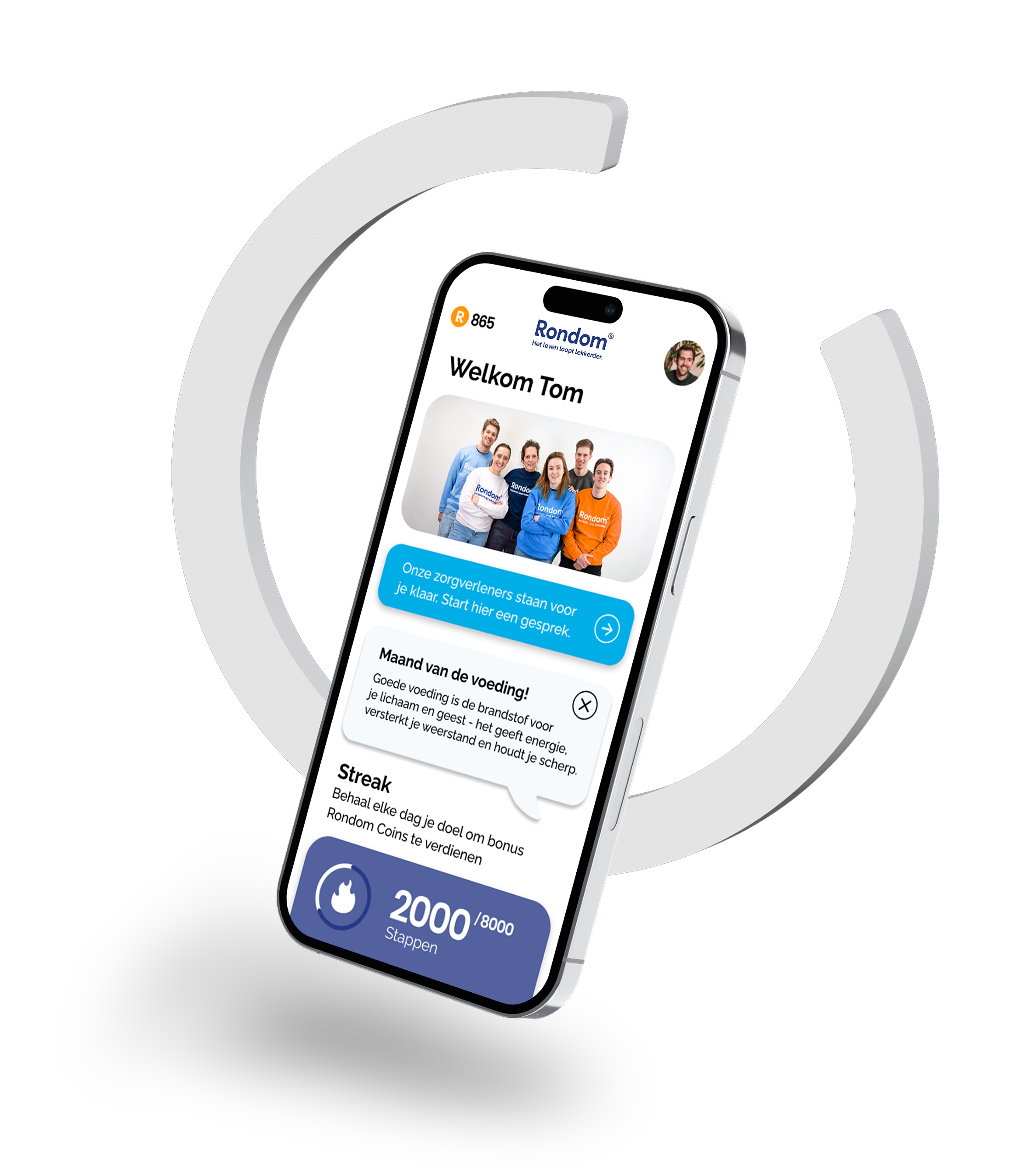
Work on your health with the Rondom app
- Direct contact with healthcare professionals via chat
- A community where you share experiences and motivate one another
- Personal challenges that match your goals
- Step counter for your daily exercise
- Earn points for healthy choices
- Articles, videos, recipes and assignments
- Register for (online) events