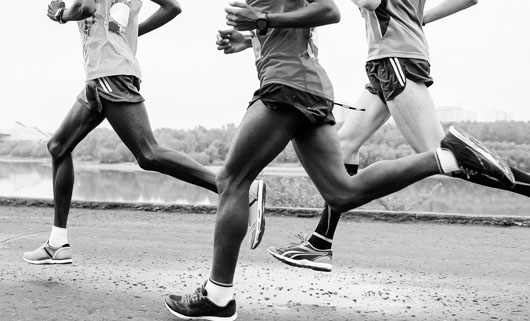
Inflammation of the tibial muscles
Inflammation of the shin muscles often causes a stabbing pain. The pain may occur at the point where the muscles attach to the inside of the foot, but also along the course of the tendons and muscles.
What are the tibial muscles?
The lower leg consists of two bones: the tibia and the fibula. These two bones are connected by a plate of connective tissue. Various muscles attach to the tibia (and partly to the connective tissue plate), including the tibialis anterior and tibialis posterior muscles.
Function of the tibialis muscle
Both tibial muscles serve to prevent the foot from rolling inwards. The front muscle also serves to lift the foot upwards at the ankle. The rear muscle moves the foot downwards. These muscles play a major role in shock absorption whilst walking. In running and jumping sports, the impacts are much greater and more is demanded of these muscles. Complaints relating to these muscles are therefore common among runners or athletes who do a lot of jumping. If overloaded, one (or sometimes both) of these muscles can become irritated; sometimes so severely that an inflammatory reaction occurs.
Causes of cramp in the shin muscle
In the case of an abnormal foot position where the foot tilts too far inwards, as well as when wearing shoes that are too soft and flimsy and when walking on uneven ground, these muscles have to work harder and irritation or strain may occur. Symptoms may also arise if there is an imbalance between the load placed on the foot and its capacity to bear that load, or if the training load is increased too quickly.
Symptoms of overworked shin muscles
There is often a stabbing pain. The pain may occur at the point where the muscles attach to the inside of the foot, but also along the course of the tendons and muscles. In the case of the posterior tibial muscle, pain is often felt just below and behind the ankle on the inner side and/or on the inner side of the lower leg. With the anterior tibial muscle, symptoms are experienced at the front of the ankle and/or at the front of the lower leg, just next to the shinbone (on the outer side). Sometimes pain is also present at night (whilst resting).
Treatment and prevention by the podiatrist
It is important to support the foot to prevent it from rolling inwards and thus reduce the pulling forces on the shin muscles. A good, sturdy and stable shoe, with or without a corrective podiatric insoles is a prerequisite. The podiatrist can shoe advice give. In some cases, the podiatrist can relieve the muscles directly by taping to be applied, thereby supporting the muscles in their function.
Footwear and sports tips
- A good counter, a good, sturdy heel cup, is important.
- The heel should be such that the calf is relaxed (max. 3 cm).
- A well-fitting shoe has its flex point below the flex point of the forefoot.
- Ensure a secure fastening across the instep, preferably with laces.
- Prevention is better than cure. Know your limits and follow a sensible training programme.
- Choose your trainers carefully. There is a suitable trainer for every foot type.
- Gradually increase your training; do not increase it by more than 10 per cent per week.
- Avoid an unusually fast sprint; do not run quickly up a hill and do not run exclusively on uneven ground such as woodland terrain.
- Asphalt road surfaces always slope away to allow for drainage. Therefore, do not walk exclusively on the left- or right-hand side of the road, but alternate sides where possible.