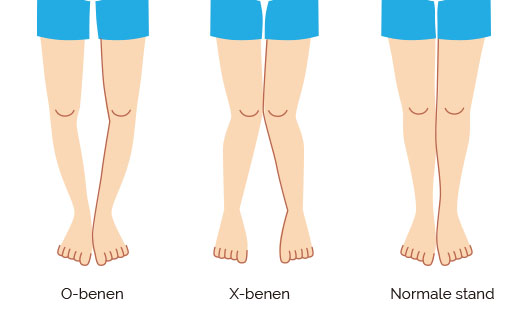
Bow legs
Bow legs, also known as Genua Vara, is the term for a leg alignment disorder in which the legs are bow-shaped. The knees bend outwards and the distance between the knees is greater than the distance between the ankles.
What are bow legs?
Bow legs, also known as Genua Vara, is the term used to describe a leg alignment disorder in which the legs are bowed. The knees bend outwards and the distance between the knees is greater than the distance between the ankles.
How do bow legs develop?
Babies are born with bow legs. When children are between one and a half and two years old, their feet turn inwards, causing their legs to straighten. The bow legs are then corrected. If this does not happen, the bow legs may become permanent.
Symptoms of bow legs
Bow legs can be recognised by the knees bending outwards and the heels pointing outwards (varus alignment). Bow legs can occur without any symptoms being present. As the condition develops gradually, symptoms appear slowly and may only cause problems at a later stage. The most common symptoms are:
- Pain on the outside of the knee
- Symptoms of instability
- Overuse of muscles and tendons
- Abnormal gait pattern
- Abnormal foot position
- Outward rolling of the foot
Treatment by the podiatrist
If there are no symptoms, it is not necessary to correct bow legs or seek treatment for them. If there are symptoms, however, and the bow legs are largely caused by the feet being turned outwards excessively, a podiatrist can provide treatment. The abnormal foot position can be corrected using podiatric insoles. As a result, the feet and knees will align more correctly, and knee symptoms caused by bow legs will diminish or disappear.