Setting boundaries as a carer
Do you find it difficult to set boundaries as a carer? Perhaps you say yes to extra tasks, even though you’re already stretched thin. Or you notice that others automatically turn to you when something needs sorting out. Setting boundaries can be tricky, especially when it comes to someone you love. Nevertheless, boundaries are important. They help you to keep up with the care and prevent you from becoming overburdened. Setting a boundary does not mean you care any less about the other person. Informal care is a (major) part of your life. But it’s important that there’s still room for work, family, social contacts and activities that matter to you.

What do you notice?
Difficulty in setting boundaries can manifest itself in many ways.
You may, for example, notice that:
- you are taking on more than you can handle;
- you don’t dare say no;
- you feel guilty when you take time for yourself;
- you take on tasks that someone else could also do;
- you are often available;
- you have little rest;
- you get angry or sad because it’s too much;
- you cancel your own appointments;
- you feel that nobody realises how much you do.
Sometimes you hope that others will realise for themselves that it is too much. But often that does not happen. In that case, clear communication is needed.
What might be the reason for this?
Setting boundaries is difficult if you feel responsible for the other person. Perhaps you’re worried that your loved one won’t be looked after properly if you do less. Or you don’t want to let family members down.
Habits also play a part. If you have been the one organising everything for a long time, others may automatically expect this of you. In that case, change can feel uncomfortable.
Furthermore, the healthcare situation can be emotionally charged. When someone is vulnerable or unwell, your own boundaries may sometimes seem less important. Yet it is precisely at such times that your boundaries need attention.
What can you do yourself?
It helps to make your boundaries clear. It’s not just about feeling that it’s too much, but about stating what you can no longer cope with.
For example, you could:
- write down which tasks you no longer wish to carry out on your own;
- indicate when you are and are not available;
- to hand over a task to family or professional carers;
- state clearly what you need;
- ask for some time to think it over before saying yes;
- protect fixed rest periods;
- practising simple grammar;
- record appointments so that they remain clear.
A boundary can be kind. You can remain engaged whilst still making it clear that something is no longer feasible.
When is it advisable to seek help?
It is wise to seek help if you consistently push your limits or if setting boundaries causes you a great deal of stress. Support can also be helpful if conflicts arise with family or your partner.
Please get in touch if you are feeling exhausted, having trouble sleeping or find that you can no longer cope with your care.
How Rondom can help
Together, we’ll explore where your limits lie and how you can make them clearer. In doing so, we’ll take into account your energy levels, care responsibilities, family commitments and emotional strain.
A occupational therapist can help to organise healthcare in a practical way and highlight what is achievable. Psychological Support can help with feelings of guilt, stress and communication. A lifestyle coach can support recovery and routine.
Together, we’ll find a way for you to stay involved without overdoing it.
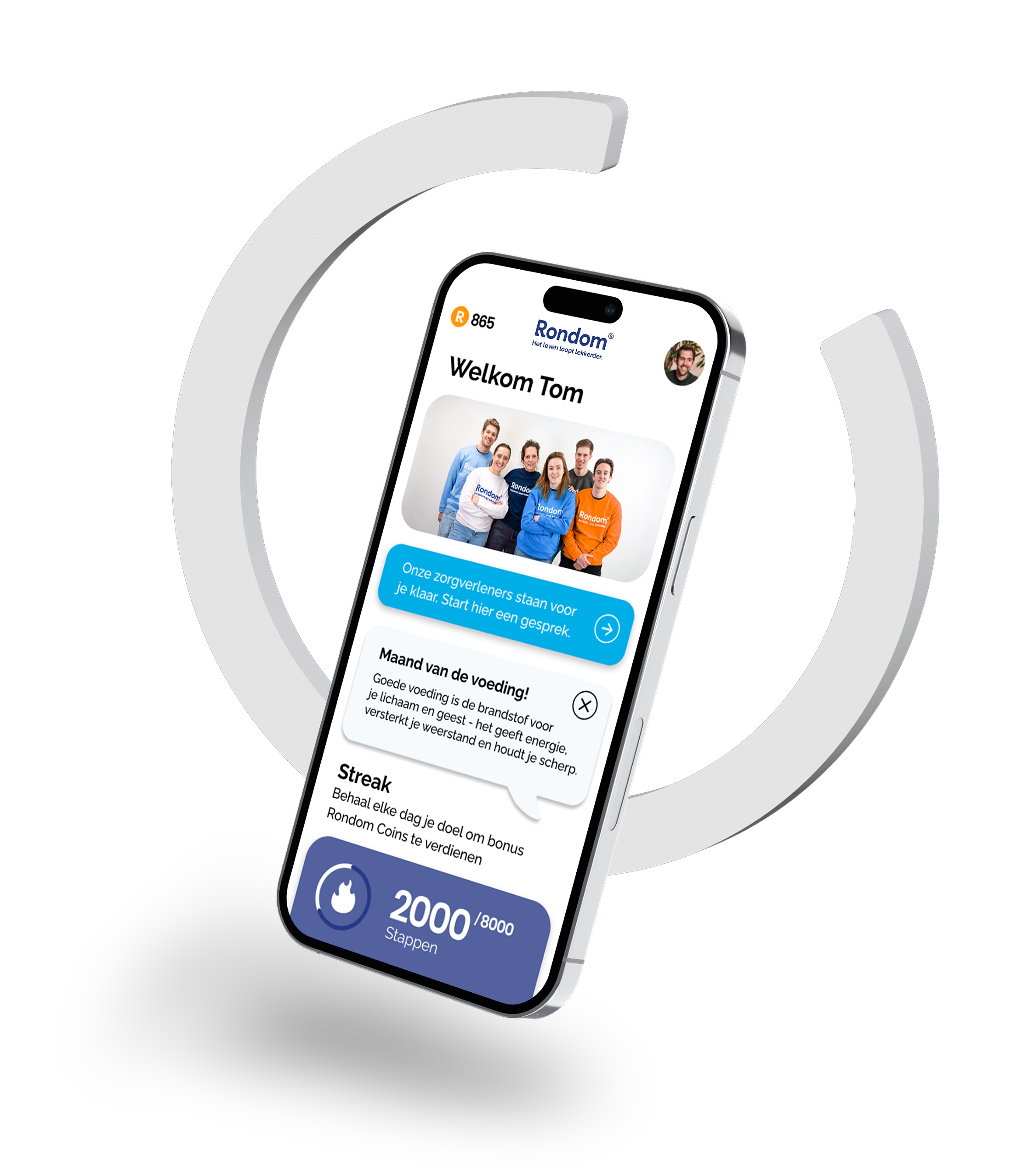
Work on your health with the Rondom app
- Direct contact with healthcare professionals via chat
- A community where you share experiences and motivate one another
- Personal challenges that match your goals
- Step counter for your daily exercise
- Earn points for healthy choices
- Articles, videos, recipes and assignments
- Register for (online) events