Asking for help without straining the relationship
Would you like to ask your partner, family or friends for help, but are you worried that this might put a strain on the relationship? Perhaps that is why you ask for less help than you actually need. Or you only ask for help when you really can’t cope any longer. This can cause tension, because the other person then suddenly has to take on a lot more. Asking for help within a relationship or family is a sensitive matter. You don’t want to ask too much of the other person. At the same time, you sometimes need support. By discussing the need for help clearly and in good time, the relationship often remains better balanced.

What do you notice?
Finding it difficult to ask for help can have a significant impact on the relationship.
You may, for example, notice that:
- you continue to take on tasks that are too demanding;
- You only ask for help when you are exhausted;
- you feel guilty;
- you’re worried that the other person might get angry or tired;
- you are asking for help in an unclear manner;
- frustration arises over expectations;
- if you feel dependent;
- you are less open about it;
- you feel alone with your symptoms.
Sometimes you think you are protecting the other person by not asking any questions. But the other person often realises that things are not going well.
What might be the reason for this?
Asking for help can be difficult due to feelings of shame, pride, guilt or past experiences. Perhaps you are used to being independent or, conversely, are the one who is always helping others.
Unclear boundaries can also cause tension. If it is not clear what you are asking for and for how long, the other person may feel that the request is too much to handle.
Furthermore, the relationship may change as assistance becomes increasingly taken for granted. That is why coordination is important.
What can you do yourself?
It helps to make support accessible, clear and open to discussion.
For example, you could:
- ask for one specific task;
- state why help is needed;
- discuss what is feasible for the other person;
- expressing thanks without apologising;
- make fixed appointments;
- distribute help amongst several people;
- keep talking about how things are going;
- also make room for ordinary time together.
A clear question is often easier for the other person to deal with than a general feeling that everything is too much.
When is it advisable to seek help?
It is wise to seek help if asking for it causes you stress or if it means you carry on for too long. Support can also help if the relationship comes under strain.
Please get in touch if the situation becomes too emotionally overwhelming or if you find yourself withdrawing more and more.
How Rondom can help
Together, we’ll look at how you can ask for help without putting too much strain on the relationship. In doing so, we’ll consider responsibilities, boundaries, communication, emotions and the other person’s capacity to cope.
A occupational therapist can help to clarify specific requests for assistance and the division of tasks. Psychological Support can help with feelings of guilt, shame and relationship strain. A lifestyle coach can support recovery and balance.
Together, we are looking for a way to make asking for help clearer, calmer and less stressful.
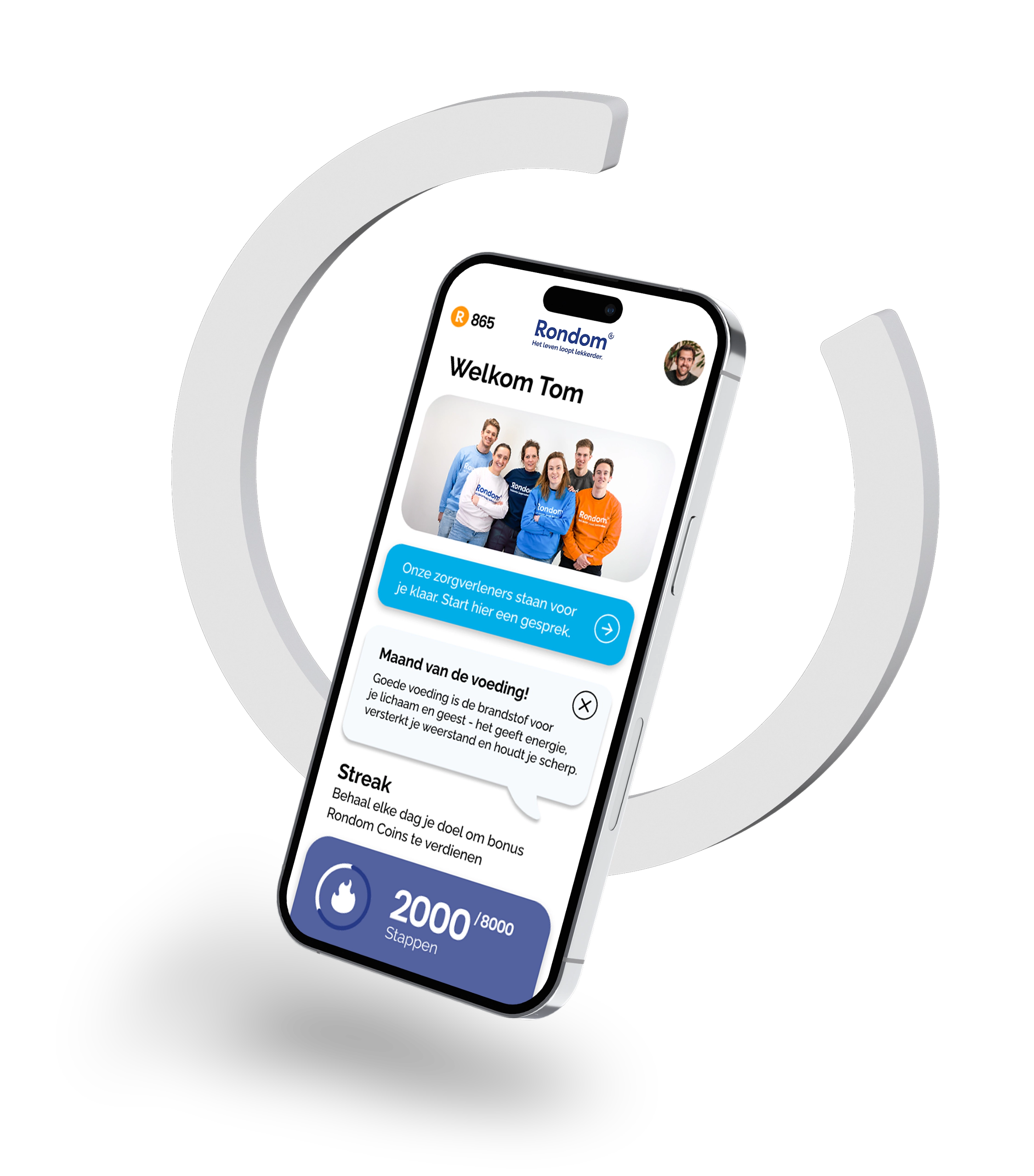
Work on your health with the Rondom app
- Direct contact with healthcare professionals via chat
- A community where you share experiences and motivate one another
- Personal challenges that match your goals
- Step counter for your daily exercise
- Earn points for healthy choices
- Articles, videos, recipes and assignments
- Register for (online) events